Companies love buying training. It feels like progress: a workshop, a binder, a certificate, done. Then ninety days later the team sells exactly the way it did before, and leadership decides "training does not work." The real problem is that most people asking about sales coaching vs training are treating two different tools like they are the same thing.
They are not. And if you buy the wrong one, you will spend real money to change nothing.
Sales training installs a skill. Sales coaching installs a habit.
Training is an event: the whole team learns a framework for discovery, follow-up, or closing. Coaching is a cadence: one rep, one coach, real calls, real feedback, week after week until the new behavior is just how they sell.
| Sales Training | Sales Coaching | |
|---|---|---|
| What it is | Teaching a skill or process | Reinforcing behavior on real deals |
| Format | Group workshop or program | 1:1 or small group, recurring |
| Timeline | A day to a few weeks | Months, on a cadence |
| Best for | Skill gaps across the team | Execution gaps in individuals |
| Fails when | There is no follow-through | There is no method to reinforce |
This is not opinion, it is one of the oldest findings in psychology. Researchers replicating the classic Ebbinghaus forgetting-curve experiments found that most newly learned material decays within days when nothing reinforces it. Your reps are not lazy. Their brains are doing exactly what brains do with information that never gets used under pressure.
Meanwhile, US companies pour more than $100 billion a year into corporate training. A huge slice of that money buys a great Tuesday and an unchanged Q3, because nobody built the reinforcement layer.
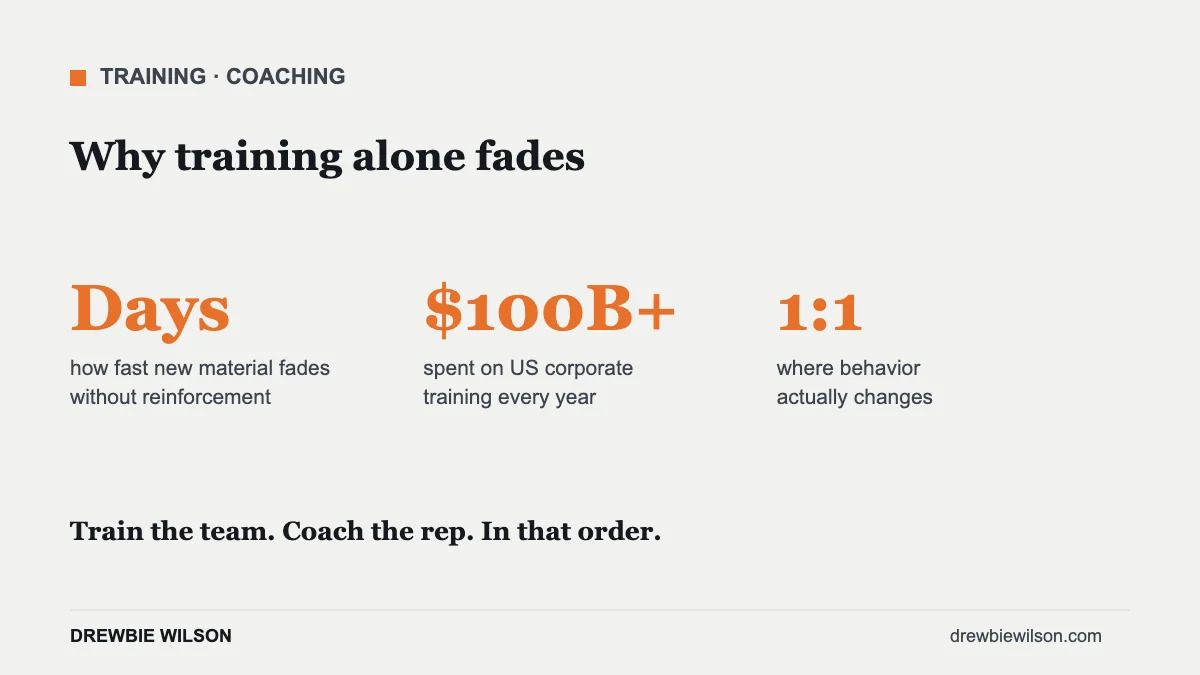
My honest take: buy training when the whole team lacks a skill. Buy coaching when reps know what to do and still do not do it. And if you cannot tell which one you have, that is a coaching problem, because it means nobody is close enough to the reps' daily work to know.
The teams that transform do it in order:
Training without coaching fades. Coaching without training has nothing to reinforce. Together, they compound.
If coaching sounds like your answer but you are picturing a vague monthly pep talk, look at the structure before you commit. Here is what 1-on-1 sales coaching looks like week by week, from the first pipeline audit through the 90-day mark.
Once you have landed on coaching, the next question is what goes in the weekly block. The SDR and AE coaching agendas spell out what to look at for each seat, and what to leave alone.
Tell me how your team sells today and where deals die. I will tell you straight whether it is a skill gap or an execution gap.
Work With DrewbieSources: Murre & Dros, Replication of the Ebbinghaus Forgetting Curve (PLOS ONE) · Training Magazine, Training Industry Report
Where the deal involves a buying committee rather than one decision maker, see enterprise sales training.