

Sales coaching for SDRs and AEs gets run as one meeting in most teams, because it is easier to book one hour than two. Then the SDRs sit through deal strategy they will not touch for two years, the AEs sit through opener drills they stopped needing in year one, and everybody leaves feeling coached without anything changing.
These are two different jobs with two different failure points. I spent twenty years on the phone and I coach both roles every week, so here is what I run for each, what I cut when the week is short, and the rubric that keeps it from turning into opinions.
An SDR's job is to create conversations. The failure is at the top: the opener dies, the objection at hello wins, or the third touch never goes out. An AE's job is to run conversations to a decision. The failure is in the middle: shallow discovery, and a deal that drifts because no next step was set on the live call.
That difference drives everything. The SDR gets coached on volume and the first twenty seconds. The AE gets coached on depth and control of the close. Same manager, same week, two different sessions.
It is worth being honest about who carries this. Gallup's long-running workplace research puts managers at up to 70% of the variance in team engagement. Whatever a program or a platform contributes, the frontline manager is the variable that moves. If coaching is not on that manager's calendar as a named block, it is not happening, and no tool fixes that.
Two things, every week. The first twenty seconds, and the follow-up that never happened.
The first twenty seconds is where the call is won or lost, and it is coachable in a way that almost nothing else is. Pull one recording. Listen only to the opening and the first objection, then stop the tape. Most reps are apologizing for calling within eight seconds, and you can hear it. Fix the tone before you touch the words.
The follow-up is the other half, and most of it is a counting problem rather than a skill problem. Before you coach persuasion, count the touches. Pull five leads the rep called once and never called again. That number, not the pitch, is the coaching conversation.
Speed is the part worth citing. The Lead Response Management study, run with Professor Oldroyd of MIT across a large body of real leads and call attempts, found the odds of qualifying a prospect fall roughly 21-fold when a response stretches from five minutes to thirty. If your rep is sitting on inbound leads for an afternoon, that is a calendar problem, not a coaching one.
What to leave alone with an SDR: pricing strategy, contract structure, multi-threading a buying committee. All real skills, none of them this person's job this quarter, and every minute spent there is a minute not spent on the opener.
With an AE, review the middle of the call, not the start. The question is whether discovery went one layer deeper than the prospect's first answer. Most AEs ask a good question, get a surface answer, say "great", and move to the next question on their list. The deal dies there, weeks before anyone notices.
Then the next-step ask. Listen to the last two minutes of any recording. If the call ends with "I'll send some times over", that deal is already slipping. The next meeting gets set while both people are still on the line, with a date and a named attendee, or it does not get set at all. That single habit moves more revenue than any script change I have ever taught.
One more for AEs who came up through the SDR seat: they will still try to win on activity. More calls will not rescue a deal that has no economic buyer in it. That is a different conversation and it needs a different fix.
Feedback that is not scored against something fixed turns into whatever the manager noticed that day. Reps feel that, and they stop trusting it. Use a rubric with the same five checkpoints every single time. Mine is the C.A.L.L.S. framework, which came out of my first book and is still the sheet I score against.
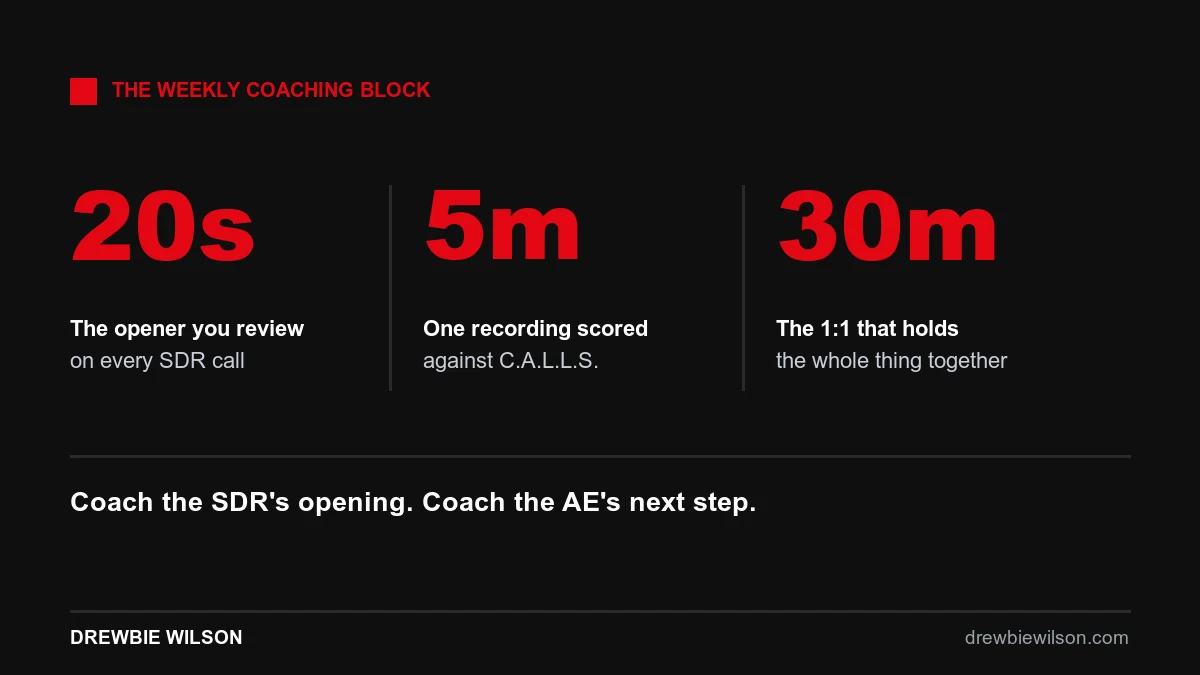
Confirm the reason you are speaking. Ask. Listen and take CRM notes. Lay out a plan. Secure the bag. Five checkpoints, one point each, scored on one real recording. Five minutes, and the rep gets a number instead of a mood.
The scoring matters less than the consistency. A rep who is scored a 3 out of 5 on the same sheet for four weeks can see which checkpoint keeps costing the point, which is a thing they can go fix on Monday. A rep who gets "that was a bit flat, be more confident" cannot do anything with it.
| What you are coaching | SDR | AE |
|---|---|---|
| Primary metric | Attempts and conversations held | Discovery depth and next steps set |
| What you review | The first twenty seconds and the first objection | The middle of discovery and the last two minutes |
| Session cadence | Short and frequent. Two touches a week beats one long hour | One 30 minute 1:1 plus one recorded call review |
| The habit to install | The touch that would have been number four | Booking the next meeting on the current call |
| Failure mode | Gives up on a lead after two attempts | Great rapport, no decision, deal sits for a quarter |
| What to leave out | Contract and pricing strategy | Dial-count drills |
Here is the block, and it fits inside a real manager's week. Thirty minutes of 1:1 per rep, plus one scored recording. That is it.
The 1:1 runs in four parts. Five minutes on the rep's own numbers, read out by the rep and not by you. Ten minutes on the one recording you scored, playing the actual audio rather than describing it. Ten minutes on one commitment for the week, written down in words the rep chose. Five minutes on anything they want to raise, which is the part everybody cuts and the part that surfaces the problems early.
When the week collapses, cut the numbers section and keep the recording. The numbers are in the CRM anyway. The recording is the only part of the hour that changes behavior. If you are building this cadence across a team of managers rather than one, that is what sales leadership training for frontline managers installs, and it is the difference between one good manager and a floor that runs the same way.
My honest take. If a rep is making twenty attempts a day, coaching the pitch is theatre. There is nothing to coach, because there is no sample. Fix the floor first, then coach the conversations. I have watched managers spend six weeks refining an opener for a rep who was making four calls a day, and everybody involved felt productive right up until the quarter closed.
The tell is simple. Look at attempts before you look at conversion. If the attempts are not there, the coaching conversation this week is about the calendar, not the call, and the honest daily call number by role is where to start. If the attempts are there and the conversations are not converting, now you have a real coaching problem and the rubric earns its keep.
Sales coaching for SDRs is a weekly habit, not an event, and the same is true one seat over for the AEs. Two roles, two agendas, one rubric, thirty minutes each. If you want somebody outside the building doing it, or you want your managers trained to run it themselves, that is exactly what one on one sales coaching with Drewbie covers. If you are still deciding whether a coach or a program is the right call, the difference between coaching and training sorts that out first, and what the first weeks of coaching look like tells you what you are buying.
I install the rubric, the weekly block and the call reviews, then I get out of the way. Tell me what your reps are missing and I will tell you which seat to fix first.
Get sales coachingSources: Gallup, Employees Want a Lot More From Their Managers · Lead Response Management Study, lead response timing research · Call The Damn Leads, the C.A.L.L.S. framework