
You have a program in front of you, a price for the whole floor, and a manager who says it looks good. The cheap way to find out if it works is to stop trying to decide for everyone at once. Pilot a sales program with one pod first: one team, one month, one decision, and a second team standing beside it as the comparison.
The reason is simple arithmetic. If it fails on ten reps, you lose a month. If it fails on a hundred reps, you lose a quarter, the goodwill of the floor, and the next three requests for training budget. Here is how to run the pilot so the result is clear enough to act on.
A rollout answers one question: did we buy it. A pilot answers the question you care about: did it change what reps do on the phone. Those are different questions, and only the second one pays you back.
Research on pilots in other fields makes the same point. A tutorial on pilot studies in BMC Medical Research Methodology argues that testing on a small scale first improves the odds the full effort succeeds and helps you avoid committing to something that was never going to work. Sales leaders are allowed to borrow the idea.
A pilot also does something a rollout cannot. It produces the first internal proof. When the second and third pods are asked to adopt something new, "pod two did it and here are their numbers" beats any deck a trainer can show.
Three rules, in this order.
Tell both pods what is happening. A control pod that finds out later it was a control pod feels used. "We are testing something with one team first, and your numbers help us decide" is true and costs nothing.
This is the step that decides whether the pilot is a test or a performance. If you set the bar after the results are in, the bar will land wherever makes the last month look sensible.
Write the pass line on one page and have the pilot manager and the person funding the rollout both sign it. It needs three things: which inputs must move, by how much, and what happens at each outcome.
Use the inputs the program is supposed to change. How to measure sales training ROI covers which numbers to baseline and how, so this post will not repeat it. Pull the same figures for the pilot pod and the control pod before day one. The 100/10/2 Standard is a daily standard of 100 attempts, 10 meaningful conversations and 2 sales closed, which makes it a ready-made yardstick for the first two numbers. For a weekly comparison, multiply the daily figure by five.
Then put a number on it. Here is an illustration: the pilot pod's conversations per 100 attempts must beat its own baseline by at least a quarter, and must beat whatever the control pod did over the same 30 days. Your numbers will differ. What matters is that the line exists in writing, before the first session. Add a floor too: if the pilot pod sits below its own baseline on day 20, pause and ask why instead of finishing the month on autopilot.
Keep the calendar boring. A pilot is not the place for extra initiatives, so freeze other changes to the pod's scripts, comp and lead routing for the month.
The manager's weekly inspection is short and specific. Open the log on the fixed day, find the one behavior reps were asked to change, and look for it in three recent calls or sent messages per rep. Name what is working, name one thing to adjust, and move on. Ten minutes per rep is plenty. A manager who turns the check into a long review teaches reps to hide the messy calls, and the messy calls are where a pilot learns the most.
Count both pods by one rule, in the same system, for the whole pilot. If the pilot manager tracks attempts one way and the control manager another, the gap between the pods is measuring spreadsheets, not selling.
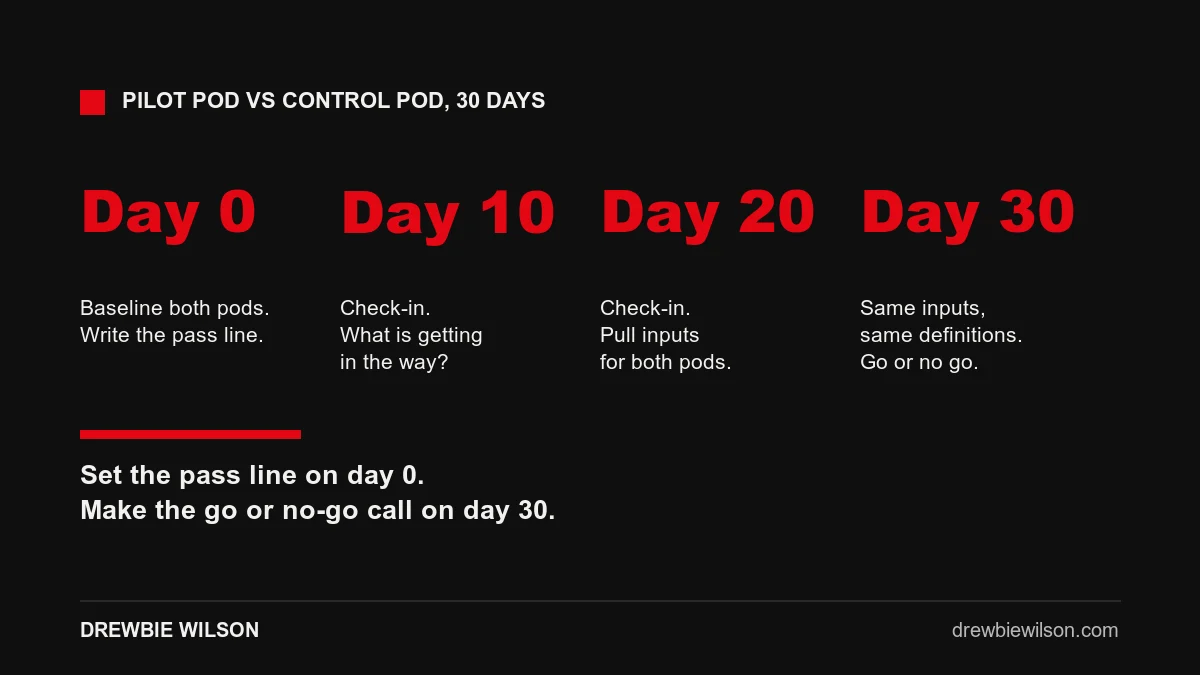
Fifteen minutes, the pass line on the table, the numbers from both pods beside it, and the two check-in notes. Nobody argues about whether the line was fair, because it was fixed on day zero. The table below shows what each signal looks like and the decision it points to.
| Signal | What it looks like in the pilot pod | What it looks like in the control pod | Decision |
|---|---|---|---|
| Target input cleared the pass line | Moved past the written line | Flat or small change | Go. Roll out to the next pod |
| Both pods improved | Moved past the line | Moved about as much | Not yet. Season, a promotion or a list change did it. Run another 30 days |
| Cleared the line early, then faded | Strong in the first 10 days, back to baseline by day 30 | Flat | Not yet. The novelty carried it. Run another 30 days with the manager inspecting |
| Pilot pod missed the line | Flat or below the written line | Flat | No go on this program as run. Check the check-in notes for what got in the way before dropping it |
| Manager skipped the reviews | Flat | Flat | Inconclusive. Rerun with inspection on a fixed day |
| Reps report it is usable | Check-in notes say they used it unprompted by week 3 | Not applicable | Supports a go. Silence from reps weakens it |
If the answer is go, the next question is what to roll out and how. Drewbie's sales team training is built around your stack, your motion, and your goals, with hands-on sessions, live practice and real scripts, so check that fit before you scale it. If the pilot showed the program works but the habit slipped, that is a manager problem, and sales leadership training is built for the people who have to hold the standard.
The honest take. A pilot is a test of whether the program can be run and whether reps change what they do. It is not proof of revenue. Thirty days is too short for closes to show up on most sales cycles, and a small pod cannot give you a precise effect size. So read inputs at 30 days, keep the pilot pod running, and read closes at a full sales cycle. A pilot with no control pod, a manager who does not inspect, or a pod picked because it was already the best will return a confident answer that means nothing.
That caution is not a reason to skip the pilot. It is a reason to be exact about what the pilot can say. When you are ready to run it, the sales process audit is the fastest way to find which number the pilot should aim at.
Sales team training is built around your stack, your motion, and your goals, with hands-on sessions, live practice and real scripts.
Get sales team trainingSources: Thabane et al., A tutorial on pilot studies: the what, why and how (BMC Medical Research Methodology) · Call The Damn Leads, the 100/10/2 outbound sales standard