
Here is the truth nobody selling you software wants to say out loud: a lead follow up system is not an app. It is a set of rules your team follows every single time a lead comes in. Who calls. How fast. What they say. What happens on day 3, day 7, day 14. Write those rules down, hold people to them, and you have a system. Skip that part, and the fanciest CRM on earth is just a very expensive place for leads to die.
I built my whole brand on three words: Call The Damn Leads. This post is the longer version of those three words. Five steps. Steal all of them.
Search this topic and you will find ten articles that all say the same thing: buy an automation tool, set up a drip, let the robots handle it. That is not a system. That is outsourcing your discipline to software and hoping.
A real lead follow up system answers four questions before the lead ever shows up:
Automation has a seat at the table. It sends the instant text while your rep is finishing another call. It reminds people. It logs things. But the system is the standard, and the standard is human.
Speed is the cheapest advantage in sales. Harvard Business Review's audit of 2,241 companies found that firms responding to a web lead within an hour were nearly 7 times more likely to have a meaningful conversation with a decision maker than firms that waited even an hour longer. And 23% of companies never responded at all. Read that again. Nearly a quarter of your competitors are donating their leads to you.
So set the standard: every inbound lead gets a call within 5 minutes during business hours. Not an email. A call. If the call gets missed, a text goes out in the same 5 minutes, something human, not a form letter.
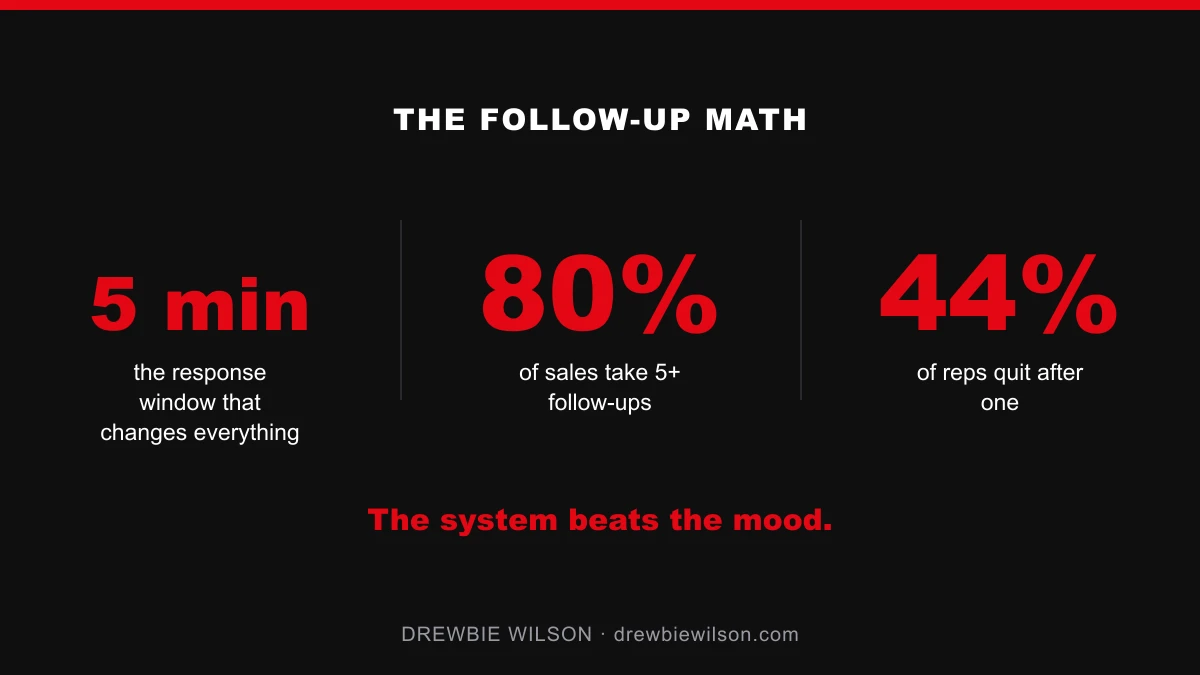
One call is not follow-up. It is a coin flip. The numbers on this are brutal: about 80% of sales require five or more follow-ups after first contact, while 44% of salespeople give up after a single attempt. The gap between those two numbers is where the money is.
Here is a 14-day cadence you can run tomorrow. Adjust channels to your market, but do not shrink the touch count.
| Day | Touch | Channel | The job of this touch |
|---|---|---|---|
| Day 1 | 1 and 2 | Call + text | Call within 5 minutes. No answer? Text: name, reason, one question. |
| Day 2 | 3 | Call + voicemail | Different time of day than touch 1. Leave a 15-second voicemail. |
| Day 4 | 4 | Deliver one useful thing: answer, price range, short video. No "just checking in." | |
| Day 6 | 5 | Call | Reference the email. Ask the one question that moves it forward. |
| Day 9 | 6 | Text | Short bump with value: "Saw this, thought of your situation." |
| Day 12 | 7 | Call | Direct ask: are we doing this or not? Respectful, not desperate. |
| Day 14 | 8 | Breakup email | "Closing your file" message. This one gets more replies than any other touch. |
After day 14, the lead moves to a monthly long-term nurture. Cold today does not mean dead forever. It usually just means "not yet."
Reps do not avoid follow-up because they are lazy. They avoid it because they do not know what to say, and nobody wants to sound like a nag. Scripts kill that excuse.
Every one of those runs on the same skeleton I teach in the C.A.L.L.S. Framework: confirm, ask, listen, lay out a plan, secure the bag. The words flex. The structure does not.
Real talk: you do not need to buy a single piece of software to start this. I have watched teams burn months "evaluating platforms" as a socially acceptable way to avoid picking up the phone. Run this cadence out of a spreadsheet for 30 days first. Earn the software.
A cadence tells you what happens to each lead. An activity standard tells you what each rep produces daily, so the pipeline never depends on how motivated anyone feels. Mine is The 100/10/2 Standard: 100 touches, 10 real conversations, 2 opportunities, every working day. I wrote the original version of it in the original 100/10/2 write-up on Call The Damn Leads, and it has held up because it measures effort, the one thing a rep fully controls.
Scale the numbers to your sales motion if you need to. What you cannot scale away is the principle: pick a daily number, make it visible, and hit it whether you feel like a rockstar or roadkill.
If your reps know the number and still stall at the phone, cold calling training is where the attempt floor gets drilled until it holds.
Every follow-up system dies the same death: it works for three weeks, someone gets busy, and six months later leads are sitting untouched for days again. The fix is boring. A 15-minute weekly review of three numbers:
Numbers slipping? Coach it that week. This is exactly the muscle we build in follow up system training for your sales team: install the standard, script the touches, and train the team until the cadence runs without anyone begging.
Build the lead follow up system once and it pays you every day after: leads answered in minutes, eight touches instead of one, scripts instead of stalling, a daily standard instead of vibes, and a weekly inspection so it never quietly falls apart. None of it is complicated. All of it is uncomfortable for about two weeks. Then it is just how your team operates, and the reps who used to "never get good leads" suddenly do.
The leads are already coming in. Call them.
A cadence only works if somebody has the hours to run it. Before you commit to eight touches over fourteen days, check how many sales calls per day is realistic for the team you have today.
If the cadence is written down and deals still leak, the problem may sit in another stage. Here is how to find and fix the broken stage in a sales process without rebuilding everything.
A cadence on paper is not a cadence in the log. A manager can confirm the eight touches happened with a fifteen-minute weekly CRM activity audit.
Drewbie builds follow-up systems with sales teams: cadence, scripts, standards, and the accountability to make them stick.
Work With DrewbieSources: Harvard Business Review: The Short Life of Online Sales Leads · Invesp: Sales Follow-Up Statistics