
Ask ten people what 1 on 1 sales coaching actually looks like and you get ten shrugs. Most reps sign up imagining a weekly pep talk. Then they either get exactly that and waste their money, or they get real coaching and are shocked that it feels more like a gym session than a therapy session.
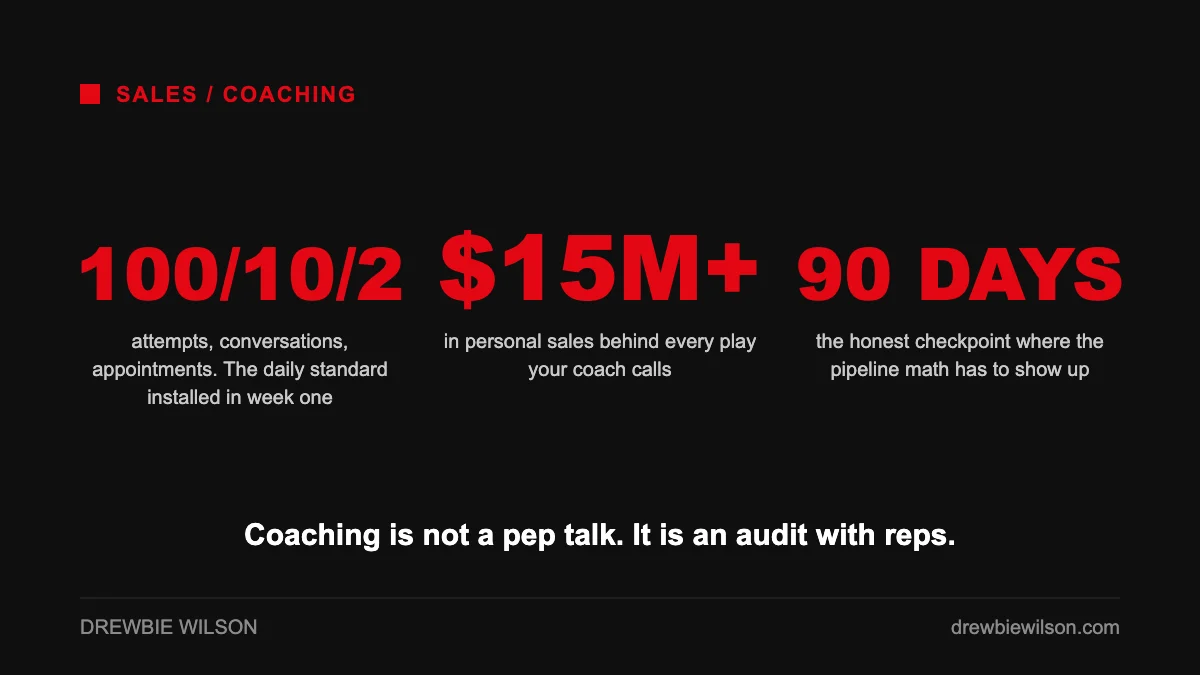
I have spent 20+ years in sales and closed $15M+ in personal sales, and here is the truth up front: good coaching is an audit with reps attached. This post walks you through what actually happens, session by session, so you know what to expect, what to bring, and how to tell inside 90 days whether it is working. Steal the checklists even if you never hire anyone.
The consensus definition is right: one on one sales coaching is a private, ongoing engagement where a coach reviews your specific pipeline, your specific calls, and your specific numbers, then builds a personal improvement plan with you. That personalization is the whole point. Group training teaches the playbook. Coaching watches YOU run the play and corrects your form in real time.
What it is not:
The test I give people: after every session you should walk away with one specific thing to change, one way to measure it, and a date it gets reviewed. No specifics, no coaching.
A real coach does not open with your goals. They open with your numbers, because the numbers never lie and feelings always do. Expect your first session to be a full teardown of the last 30 days. Show up with:
By the end of session one you should hear a sentence like: "Your problem is not closing, it is that you only had 11 real conversations last week." That sentence is worth the whole month.
The first month of coaching is rarely about technique. It is about volume, because most "skill problems" are starvation problems. This is where I install the 100/10/2 Standard: 100 attempts, 10 real conversations, 2 booked appointments, every working day. The standard has an origin story too; the original 100/10/2 write-up on Call The Damn Leads is where it was first published.
Run the math on what that compounds into:
Compare that to the rep averaging 15 attempts a day and wondering why coaching "is not working." No coach on earth can out-coach an empty pipeline. Expect your coach to hold the standard before they polish a single objection response. If yours does not ask about daily activity in the first two weeks, that is a red flag with a spotlight on it.
Here is the working cadence of a real engagement once the standard is installed. Your version may shift by a day, but the shape should look like this:
| Day | What happens | What you bring | Metric reviewed |
|---|---|---|---|
| Monday | Live 1:1 session (45 to 60 min): call review + one drill | 2 recorded calls, last week's scorecard | Conversations per day |
| Tuesday to Thursday | You run call blocks against the standard | Daily one-line activity log | 100/10/2 hit or missed |
| Wednesday | Async check: coach reviews one call clip, sends notes | One 5-minute call clip | One skill focus (openers, asks, closes) |
| Friday | Scorecard submitted: numbers plus one win, one leak | Weekly totals | Appointments booked |
Notice what is missing: homework packets, personality assessments, vision boards. Coaching that works is boring on paper and uncomfortable on the phone. That is the deal.
The heart of every session is call review, and you need a shared language for it or feedback turns into vibes. Mine is the C.A.L.L.S. Framework, and here is exactly what a coach listens for at each step of your recording:
Expect to be scored on all five, on real recordings, most weeks. It stings for about three sessions. Then your calls start sounding different and the sting turns into a scoreboard.
Do not judge coaching by how fired up you feel. Judge it by leading indicators first, results second:
The research backs the checkpoint discipline: a Harvard Business Review analysis of sales coaching found that real coaching moves core performers the most, with quality coaching lifting the middle of the pack by up to 19%. Translation: coaching pays when it is measured, on the reps who actually do the work.
Write these checkpoints down before you start and review them with your coach on the calendar dates. A good coach will beat you to it, because their renewal case IS your scoreboard. If you get a wobble on the phone before those call blocks even start, fix that first: how to overcome call reluctance.
Print these and ask them on the discovery call:
If you want the version of all this where the audit, the standard, and the weekly call reviews are done with you instead of by you, that is exactly what 1:1 sales coaching with Drewbie is built to do.
Expect an audit, not applause. Expect a daily standard before a single slick technique. Expect your real calls on the table every week, scored against a framework, with numbers that either move by day 90 or tell you to change something. That is what 1 on 1 sales coaching looks like when it is real, and now you know exactly what to demand.
The leads are already there. Call them.
What a manager runs in-house every week is a different session again, and it changes by seat. Coaching an SDR versus coaching an AE sets out both agendas and the rubric underneath them.
Drewbie runs 1:1 coaching the way it is described above: audit first, standard second, reps forever. Bring your ugly CRM data. That is the fun part.
Work With DrewbieSources: Sales coaching impact on core performers via Harvard Business Review, "The Dirty Secret of Effective Sales Coaching". The 100/10/2 Standard and C.A.L.L.S. Framework are Drewbie Wilson's own published methodology; origin write-up on Call The Damn Leads.