
Most owners ask “should I hire a sales consultant?” about six months after the answer became yes. The deals that died in that window didn’t die because your people were lazy. They died because nobody could answer three questions: who follows up, when, and how many times. That’s not a talent gap. That’s a system gap, and knowing when to hire a sales consultant starts with recognizing which one you have.
Missed quota is a symptom. Before you spend a dollar, run this test tonight: pull your last 20 closed-lost deals and write down the date of the last touch on each one. If more than half died after one or two touches, you don’t have a closing problem. You have a follow-up problem, and follow-up problems are process problems.
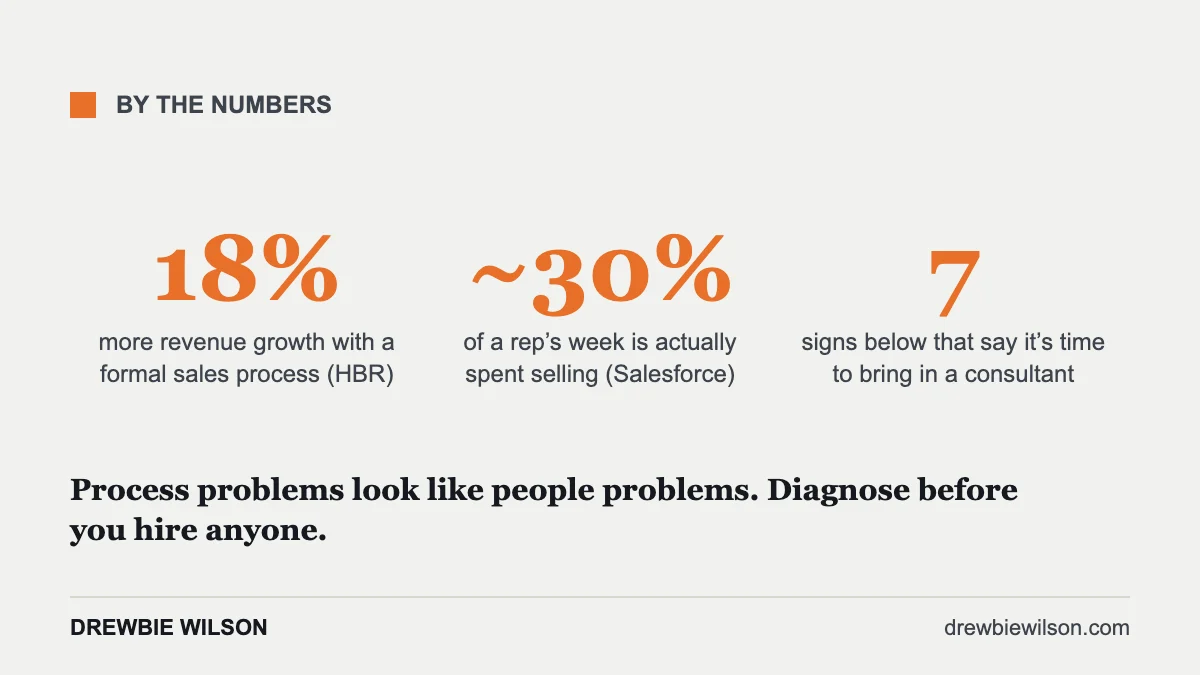
The research backs the fix. Harvard Business Review found that companies with a formal, documented sales process see up to 18% more revenue growth than companies that wing it. Process is the highest-percentage bet in sales, and it’s exactly what a real consultant builds.
You paid for the lead, someone filled out the form, and then… silence. If there is no written answer to “who calls, within how many minutes, and what do they say,” every lead is a coin flip.
A plateau means the process that got you here is maxed out. More effort inside a broken system just produces more exhaustion.
You can’t hire your way out of an undocumented process. Every new rep just learns the chaos slower than you run it.
Thousands of contacts, no stages, no next actions. Salesforce’s State of Sales research puts real selling time at roughly 30% of a rep’s week; the rest gets eaten by admin and hunting for information. A dirty CRM is where that time goes to die.
No shared framework means wins aren’t repeatable and losses aren’t diagnosable. You’re not running one sales team, you’re running five solo acts.
Hiring reps two through five onto a broken process multiplies the broken. Fix the machine before you add operators.
Most deals take multiple touches. If your team quits after one attempt, the fix is scripts, a cadence, and a daily standard. That’s system work, not a motivational poster.
That’s a marketing problem. A sales consultant makes existing demand convert; they don’t conjure demand from nothing. Fix lead flow first.
Be honest. If there are 200 uncalled leads sitting in your inbox, you don’t need a consultant, you need to call the damn leads. Do the unglamorous thing first, then bring in help to systematize it.
If you expect one phrase to double your close rate, save your money. Consultants build systems that compound. Anyone selling spells is selling you.
These get used interchangeably and they are not the same purchase. If you’re not sure which you need, this breakdown of coaching vs training goes deeper.
| Role | What they change | What you walk away with | Best when |
|---|---|---|---|
| Sales consultant | The system | Documented process, follow-up cadence, CRM discipline | Process is undocumented or broken |
| Sales coach | The person | Sharper skills, accountability, mindset | System works, a rep or founder is stuck |
| Sales trainer | The team’s skills | Shared framework, live practice | Team executes inconsistently |
Hold anyone you interview, including me, to this deliverables list:
A framework is what makes the process teachable. Mine is the C.A.L.L.S. Framework: Confirm, Ask, Listen, Lay Out a Plan, Secure the Bag. Whatever framework your consultant installs, make sure it fits on one page and a new rep can run it in week one.
My honest take: most companies don’t need a consultant for a year. They need a defined engagement with a defined handoff. If a consultant can’t tell you what “done” looks like, you’re not buying an engagement, you’re buying a subscription.
My sales consulting engagements start at $1,000, and I state that in public because vague pricing wastes everyone’s time. Run the math on your side: pull those 20 closed-lost deals again and price the ones that died from silence. For most businesses, recovering a handful of dead leads pays for the entire engagement.
Before you bring anyone in, spend an afternoon on a do-it-yourself sales process audit. Scoring your own six stages first means any consultant you hire starts from evidence instead of guesswork, and you may even find the leak on your own.
If you would rather attempt the repair yourself first, start with how to fix a broken sales process. If you bring in a trainer instead, measure the training on inputs, not revenue.
If a trainer is the better fit than a consultant, put the shortlist through a checklist for evaluating sales training vendors before you sign.
Tell me what your follow-up looks like today and I’ll tell you where the revenue is leaking.
Work With DrewbieSources: Harvard Business Review, “Companies with a Formal Sales Process Generate More Revenue” · Salesforce, State of Sales
If the gap is enterprise deal cycles specifically, see enterprise sales training.