
Most advice on how to ask better sales questions is a list. Seventy questions, fifty questions, a PDF you print and tape next to the monitor. Reps read it, pick three that sound smart, and go right back to talking over the prospect the moment the prospect starts answering.
The list was never the problem. I have listened to a lot of discovery calls, and the pattern barely changes: a decent question, a half answer, and then the rep jumps in with a pitch because the pause felt long. Here is how I teach reps to ask better sales questions: what each question is for, how to phrase it so people open up, what to do with the answer, and how to tell when better questions are not what your pipeline needs.
A list gives you wording. It does not give you a reason to ask, an order to ask in, or a plan for the answer. Alison Wood Brooks and Leslie John make a version of this point in their Harvard Business Review piece on the power of questions: few executives treat questioning as a skill that can be honed, and the type, tone, sequence and framing of a question all shape what comes back. Sequence is the part every list skips.
On the calls I hear, three habits show up over and over:
The fix for all three is the same. One question, one answer, and let the answer pick the next question.
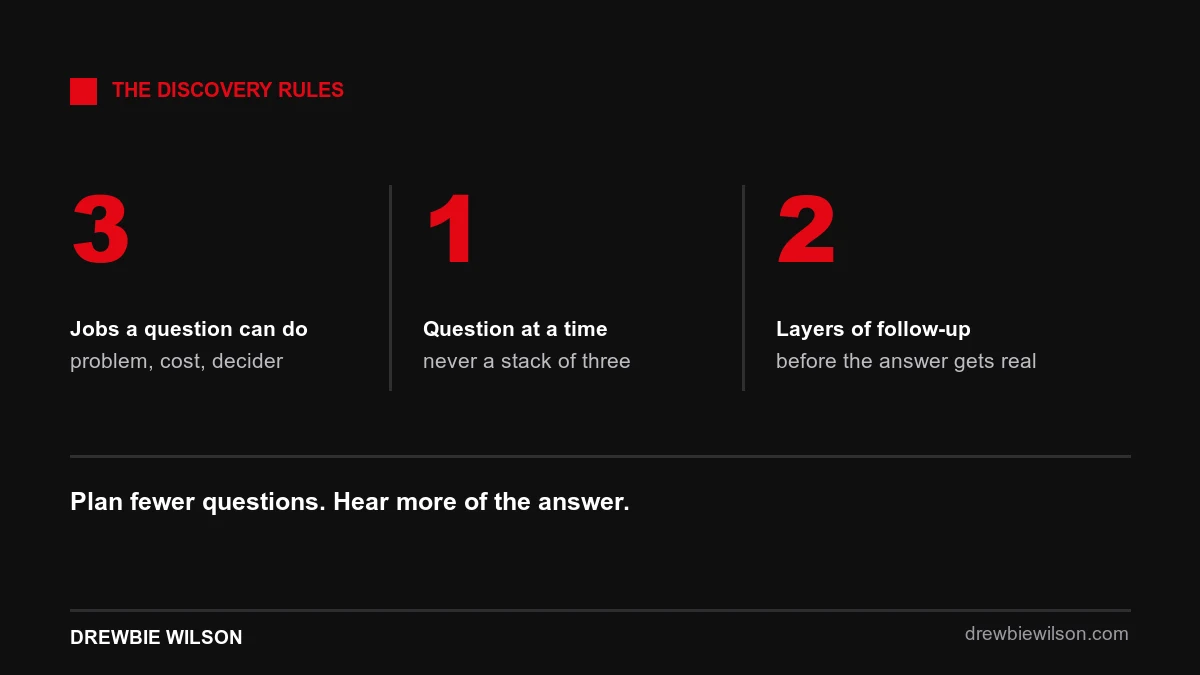
Every question you plan for a call should have a job. There are only three jobs worth doing in discovery. The questions sit inside a bigger call structure, which Call The Damn Leads lays out step by step in the discovery sales process. This post stays on the questions.
"What made you take this call this week?" is better than "What are your pain points?" because it asks about something real that happened. Pay attention to the exact words they use. You will hand those words back to them later when you lay out a plan, and people trust a plan built from their own description of the problem.
A problem with no cost is a someday problem. "How many of last month's leads never got a second call?" or "What happens if this still looks the same in six months?" turns a complaint into a number or a consequence, and that is what moves a deal off the fence.
"Who else will want a say before anything changes?" Ask it early. Reps who wait until the close to find the second decision maker end up restarting the sale with somebody who was never in the room.
Here is the prep test I give every rep. Before the call, write down the five questions you plan to ask and mark each one P, C or D for problem, cost or decider. Anything you cannot mark is small talk or a pitch. Cut it or move it to the end.
"Why" feels like an accusation even when you do not mean it that way. "Why haven't you fixed this yet?" makes a buyer defend a decision. "What has gotten in the way of fixing this?" invites them to explain it. Same information, completely different temperature on the call.
Open and closed questions both have a place. Open questions start a thread: they find the problem and let the buyer talk. Closed questions end a thread: "So the budget is already approved for this year?" locks in a fact before you move on. Reps get in trouble when they open with closed questions and get a string of yes and no answers, then decide the prospect is cold.
In the C.A.L.L.S. framework I teach, Ask is only step two. The steps run Confirm the reason you are speaking, Ask, Listen and take CRM notes, Lay out a plan, Secure the bag. The question is half the move. Listening is the other half, and it is the half most reps skip.
Three habits make the listening real:
If you want to ask better sales questions starting tomorrow, the pause is the cheapest change you can make.
Here are the six places discovery calls go soft, with the question most reps ask, the version that works better, and what the better answer gives you.
| Topic | What most reps ask | The better version | What the answer gets you |
|---|---|---|---|
| The problem | "What are your pain points?" | "Walk me through what happens after a lead comes in." | The real process, with the gaps showing |
| Budget | "What's your budget?" | "What are you spending on this problem today, in money or hours?" | A cost to compare against, not a number to haggle down |
| Timeline | "When are you looking to buy?" | "What needs to be true by the end of the quarter?" | A date tied to their goal, not your forecast |
| Decision | "Are you the decision maker?" | "Who else will want a say before this changes?" | The whole committee, without insulting the person on the call |
| Other options | "Who else are you talking to?" | "What would the right fix have to do that nothing so far has done?" | Their buying criteria, in their words |
| Next step | "Does that sound good?" | "What would you need to see to take this to your team next week?" | A booked next step instead of a maybe |
The first answer to any good question is the surface. The follow-up is where you find out what is going on. Here is a real shape of it:
"What happens after a lead comes in?" "Someone calls them." "Who, and how fast?" "Whoever is free, usually the same day." "What happens to the ones nobody gets to by end of day?" Now you are at the real problem, and you got there in three questions instead of thirty.
A few rules keep follow-ups from turning into an interrogation:
When discovery is done this way, the end of the call gets easier too. You are not pushing, you are reading back what they told you, which is the whole idea behind closing a sale without the pressure.
The honest take. Question craft only matters once conversations are happening. If a rep is not getting enough conversations in the first place, a better discovery script changes nothing, because there is no call to run it on. Look at attempts before you look at discovery. How many calls a rep should make each day is the first number to check. If the attempts are low because the rep dreads the phone, that is call reluctance, and it needs its own fix.
If the conversations are happening and discovery is still thin, that is a coaching problem, and it is fixable in weeks. It is exactly what one on one sales coaching with Drewbie works on: weekly sessions on your numbers and live deals, working the specific calls you are stuck on until the follow-up question is a habit. If it is the whole team, sales team training built around discovery and follow-up gets everyone running the same questions in the same order.
You do not need a longer list to ask better sales questions. You need to know what each question is for, phrase it so people answer instead of defend, and stop talking long enough to hear the answer. Try it on your next five calls: plan three questions, mark each one P, C or D, and write down the buyer's exact words.
The same question does not fit every seat. Discovery questions by buying committee role shows what to ask each person on a committee deal.
We review your numbers and live deals every week and work the specific calls you are stuck on. Tell me where your deals stall and I will tell you which question is missing.
Get sales coachingSources: Harvard Business Review, The Surprising Power of Questions (Brooks and John) · Call The Damn Leads, the C.A.L.L.S. framework · Call The Damn Leads, the discovery sales process