
Every rep who has ever carried a quota has sat there staring at a phone that suddenly weighs 400 pounds. You reorganize your CRM. You "research" the prospect for the ninth time. You get another coffee. That is call reluctance, and if you are wondering how to overcome call reluctance, the honest answer is not a pep talk. It is a routine you run on your body before your brain has a chance to talk you out of it.
I built a whole brand on three words: Call The Damn Leads. This post is the how. A 5-minute reset, the exact lines to say, what to do in the 30 seconds after a no, and a call-block method that ties straight back to the daily standard. Steal all of it.
Search this and every article says the same true thing: call reluctance is the emotional hesitation, anxiety, and avoidance that stop a salesperson from initiating contact, and the standard fix is to make the task smaller so the fear has nothing to grab. That consensus is correct. You do not beat a wall of 80 calls. You beat one call, then the next one.
Here is the refinement that actually holds up under pressure: reluctance is rarely about the phone. It is about what you have riding on the phone. When your pipeline is thin, every call is auditioning to save your month, and that pressure is what freezes your hand. When your pipeline is full, a single no is a rounding error. So the one-line fix is behavioral and structural at the same time: shrink the task, then fatten the pipeline so no task is scary.
Skip the vague "you lack confidence" diagnosis. Reluctance almost always traces to one of three concrete causes, and each has a concrete fix.
Self-diagnostic (60 seconds, be honest):
Two or more boxes checked means the routine below is for you today, not someday.
This is a physical sequence, not a mindset. Do it in order. It takes five minutes and it works because it moves the decision out of your anxious brain and into your body.
Memorize these. When the words are automatic, the fear has nothing to hold onto.
The 3-line pre-call primer (say to yourself before you dial):
The first-90-seconds cold-call opener (say to them, verbatim):
"Hey [name], this is [your name] with [company]. I know I am an interruption, so I will be quick. I work with [type of person] who are dealing with [specific problem], and I had one reason for calling. Can I take 30 seconds to tell you why, and you can tell me if it is worth continuing?"
Then stop talking. That pattern does three things: it is honest about the interruption (which disarms people), it names a real problem, and it hands them control with a yes/no they can actually answer. Nine times out of ten you get your 30 seconds. The tenth time you get a fast no, and a fast no is a gift.
The reason one rejection turns into an hour of avoidance is that reps do not close the loop. They carry the sting into the next dial, sound wounded, and get another no. Break the chain in 30 seconds:
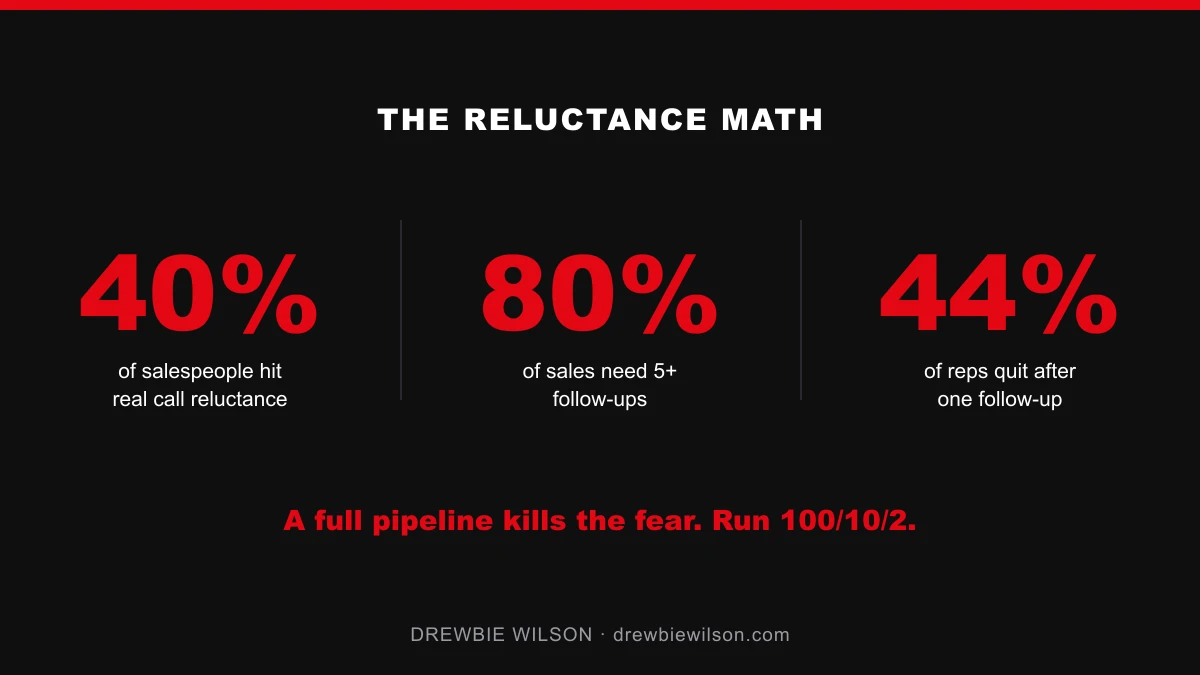
The math is on your side here: roughly 80% of sales take five or more follow-up attempts, yet about 44% of reps quit after one. Most people are quitting exactly where the deals actually start. If you keep dialing when others stop, you win by default.
Willpower runs out. Structure does not. Instead of "make calls today," you run timed blocks with a fixed dial count, so the decision is already made before you sit down.
| Block | Length | Target | Rule |
|---|---|---|---|
| Warm-up block | 25 min | 15-20 dials | First block of the day, no exceptions, before email. Run the 5-minute reset first. |
| Power block | 50 min | 30-40 dials | Phone only. No CRM cleanup, no "research," no inbox. Dial, log one line, dial again. |
| Recovery | 10 min | 0 dials | Stand, walk, water. Protects the next block's energy. Then repeat a power block. |
The rules that make it work: a visible timer, phone-only during the block, and you log results in one line so admin never becomes a hiding place. Stack three or four blocks and the daily numbers take care of themselves.
Teams that want the blocks installed for everyone at once run them inside cold calling training, and a sales kickoff can open with the outbound sales keynote so the daily number is set before the first block.
That daily number is the whole point. Tie every call block to the 100/10/2 standard: 100 attempts, 10 real conversations, 2 appointments, every working day. Hit that and your pipeline gets so full that reluctance starves. This is exactly the muscle we rebuild inside 1:1 sales coaching that rebuilds your phone confidence: install the standard, script the calls, and drill the resets until dialing is just what you do, not a decision you have to win every morning.
Print it. Tape it to your monitor. Run it top to bottom before every call block.
Call reluctance is not a character flaw and it is not permanent. It is a predictable reaction to a thin pipeline, a missing script, and unprocessed rejection, and every one of those has a fix you just read. Run the 5-minute reset, say the lines, reset in 30 seconds after a no, and structure your day into blocks that feed 100/10/2. Do that and the phone stops weighing 400 pounds. It goes back to being what it always was: the fastest tool you own for making money.
The leads are already there. Call them.
The standard that starves reluctance has an origin story. Read the original 100/10/2 write-up on Call The Damn Leads.
Accountability is the piece most reluctant callers are missing, and it is exactly what a coach supplies. If you are weighing that route, this breakdown of what to expect from one-on-one sales coaching shows how the weekly call reviews and dial standards work in practice.
Call reluctance in one rep is a confidence problem. The same avoidance across a whole floor is usually burnout, and it needs a different fix - here is how to get a burned-out sales team dialing again.
Once the fear is handled, the next question is volume. The honest number of sales calls per day covers what to aim for and the two windows that convert best.
Reluctance is usually a coaching problem before it is a confidence problem. The weekly coaching block that keeps the dialing honest shows what a manager should be scoring, starting with attempts.
Part of the dread goes away when you know what you will say after hello. A better set of sales questions gives you the next line, and the one after it.
Drewbie coaches salespeople through the exact routines, scripts, and standards that turn dialing from a daily battle into a default. No fluff, just reps.
Work With DrewbieSources: Call reluctance prevalence via Behavioral Sciences Research Press (Dudley and Goodson, "The Psychology of Sales Call Reluctance"). Follow-up persistence statistics (80% of sales need 5+ follow-ups; 44% quit after one) via Invesp.