
If you are searching how to motivate a sales team, you are not looking for a poster. You are looking at a floor that used to hit and now does not, at reps who answer in one word, and at a bonus plan that stopped moving anybody two quarters ago. I have stood in front of a lot of those rooms.
Twenty-plus years and $15M+ in personal sales taught me one thing about the burned-out team: they are not lazy and they do not need a speech. They have lost the connection between what they do all day and what shows up in their bank account. Rebuild that connection and the mood follows. Try it the other way around and you get a good Monday and a dead Thursday.
The World Health Organization put burn-out in the ICD-11 as a syndrome from chronic workplace stress that has not been successfully managed, with three parts: energy depletion, mental distance from the job, and reduced professional efficacy. Read those three again with a sales rep in mind. Tired, checked out, and convinced they are not good at this any more.
Now look at what pressure does to each one. A longer pipeline review takes more energy. A public callout adds distance. A stretch quota on a rep who missed the normal one confirms the third. You are adding load to someone already at the top of what they can carry.
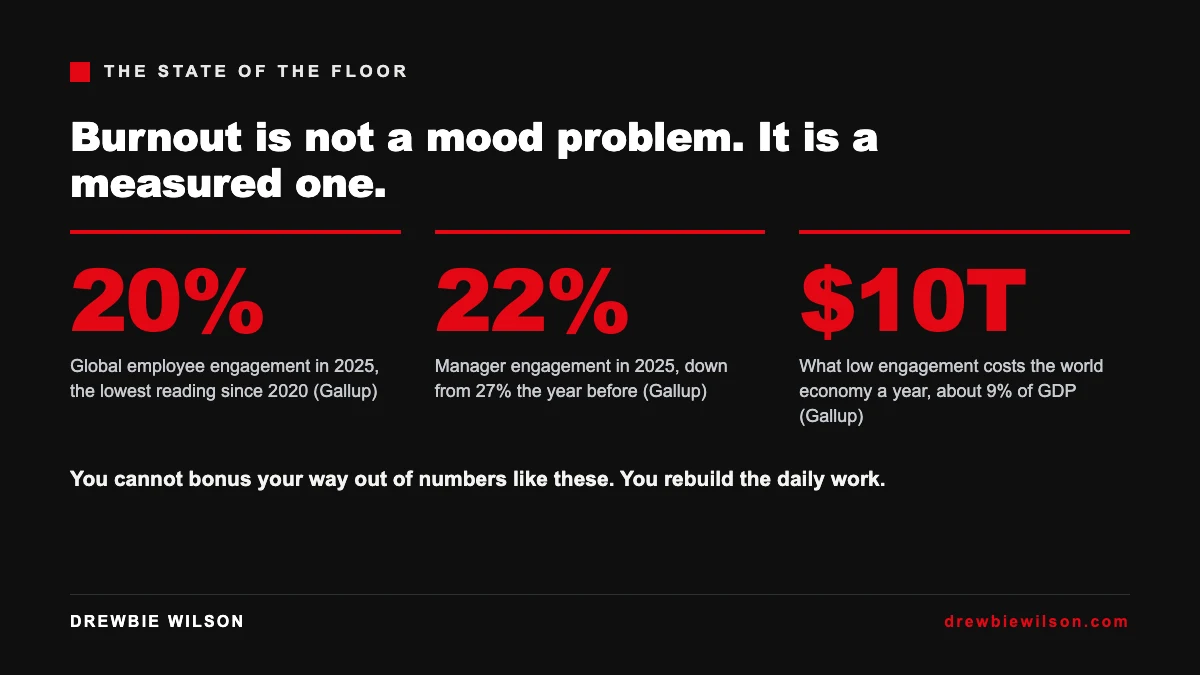
Gallup's 2025 read has global employee engagement at 20%, the lowest since 2020, manager engagement down to 22% from 27%, and low engagement costing the world economy about $10 trillion a year. Your team is not uniquely broken. That also means nobody is coming to fix it for you.
Do this today. Cut your next pipeline review in half and hand the time back as a protected call block. That is a real change your reps will feel by Friday, and it costs you nothing but your own meeting.
Three problems look identical from a manager's chair: a burned-out rep, a broken process, and the wrong person in the seat. The fixes are different, and guessing wrong makes it worse. Sit down one on one and ask three questions in this order.
Score it on the spot. Low activity plus high dread is burnout. High activity plus no results is a broken process or a bad list. Low activity plus no dread is the wrong seat, and that is a hiring conversation.
When the number is missing, revenue becomes a punishment metric. You put it on the board every morning and every morning it tells eight people they are failing. That is the most common mistake I see.
Swap the scoreboard for ten working days. Track two things only: attempts and real conversations. Both are entirely inside the rep's control, both move the same day someone decides to move them, and both are honest leading indicators of the revenue you want.
Then make the sprint winnable. Pick a target the team can hit on a normal day, not a heroic one. A burned-out floor needs proof that effort still produces an outcome, and the fastest way to give it to them is a bar they clear on day one and keep clearing. Raise it in week three.
Publish both numbers by name every afternoon and praise specifics. Not "great job team." Try "Marcus had nine conversations and two were with people who have never picked up." Specific praise is free and it is the only recognition reps believe.
Here is the part the recognition platforms skip. Motivation is downstream of math. A rep who knows exactly what their day has to look like to produce a close stops needing to be inspired.
That is what the 100/10/2 Standard is for. One hundred attempts, ten real conversations, two closes. I ran that ratio for two decades, and the point is not the number on the left. The point is that it has a number on the right attached to it. Effort with a known payout is a motivating job.
On a burned-out team, do not open at 100. Open at half and hold it for two weeks without missing a day. Fifty every day beats a heroic hundred followed by three days of nothing, and the team relearns something they stopped believing: the work still works.
Most managers reach for the same levers in the same order. All of them are cheap to announce and slow to matter.
| What managers reach for | What it really does | What works instead |
|---|---|---|
| A bigger spiff or contest | Moves the top two reps who were going to hit anyway. The bottom half stops watching on day three. | A daily activity floor everyone can clear, tracked publicly by name. |
| A longer pipeline review | Takes selling hours from the people who need them most. | Fifteen minutes, three deals, one commitment each. Then get off the call. |
| A new CRM field or dashboard | Adds admin. Nobody closed a deal because a field was required. | Delete a field. Give the minutes back as call time. |
| A motivational email on Monday | Read in four seconds, forgotten in five. Words with no change behind them devalue the next one. | Ride along on two live calls and take the hard one yourself while they listen. |
| Raising the quota to "stretch" them | Confirms the story a burned-out rep is already telling themselves. | Hold the quota, shorten the horizon. Win the week, then the month. |
Four weeks, one change a week, nothing purchased. Run it in order and do not skip ahead, because each week depends on the one before it.
Week 1, subtract. Run the three-question 1:1 with every rep. Delete one thing per person and one thing from the team calendar. Announce nothing new. The week is about proving you will take work away, not add it.
Week 2, set the floor. Pick the attempts and conversations target the team can hit on an ordinary day. Post it. Track it by name every afternoon. Praise specifics, never generalities. Ignore revenue on the board this week entirely.
Week 3, coach the conversation. Sit in on two live calls per rep. Do not score them. Ask what they would change and let them answer first. If the whole team needs the same fix, that is when structured sales team training earns its keep instead of another all-hands.
Week 4, raise it and re-measure. Lift the floor by about 20%. Put revenue back on the board next to the activity numbers so the team sees the connection they lost. Compare week 4 against week 1 out loud, in front of everybody.
The reset is not clever. It is four things in the right order, done by a manager who did not flinch. That is most of the job.
My honest take. A keynote will not fix a broken comp plan, a bad manager, or a product nobody wants. If any of those three is your real problem, hiring a speaker is a bandage on a bone break, and I will tell you that on the call before I take your money.
Here is when an outside voice does pay. When a team has stopped believing the number is possible, they will not hear it from the person who set the number. They hear it from somebody who has lived the grind and can say it without a slide deck. Kickoffs, post-reorg resets, and the middle of a bad quarter are where that lands hardest.
That is the work I do. If your floor needs the belief rebuilt before the process can stick, you can hire Drewbie Wilson as a sales motivational speaker for your kickoff or your quarterly reset. And if you are still deciding whether the spend makes sense at all, I wrote an unflattering answer to that question in are motivational speakers worth it.
That is how to motivate a sales team without buying anything: diagnose in one 1:1, shrink the scoreboard, set a floor they can clear, coach the calls, re-measure in 30 days. Do that first. Bring in an outside voice when belief is the gap, not the plan.
Swapping the revenue number for an activity number only helps if the activity number is reachable. Here is how many sales calls per day fits in a working day.
If the reset you need is the annual kickoff itself, a kickoff speaker who hands the room a daily number is the version of this that runs on stage.
They need a daily number that works and somebody who has run it. Let's talk about your kickoff or your team reset.
Book Drewbie to speakSources: World Health Organization, Burn-out an occupational phenomenon (ICD-11) · Gallup, State of the Global Workplace · American Psychological Association, work stress and burnout