
Search for a sales manager CRM activity audit and you get CRM vendor documentation: where the activity report lives, how to export it, how to clean up duplicate records at the end of the year. Useful if your CRM is a mess. Useless if your question is the one every sales manager has on a Monday morning: did the follow-up my reps promised me last week happen, or did it not?
That question has a fifteen-minute answer, and it does not need a new dashboard. It needs three numbers, a standard to hold them against, and a routine you run every week whether the quarter is good or bad. Here is the one I run, and the conversation that follows when a number is short.
Every CRM I have worked in logs three things that answer the question, and none of them is on the default dashboard. The dashboard shows pipeline value and stage counts, which are outputs. The audit needs the inputs, per rep, for the last five working days.
The fourth field, and the one most managers have never opened, is the activity history on the leads marked lost or stalled in the period. How many touches did each one get before the rep stopped? If the answer is two, you have found the leak, and no amount of pipeline review will fix it until a manager looks at it every week.
If your CRM cannot produce those four in an afternoon, fix that first. Call The Damn Leads has the rep-side guide to using a CRM so leads stop dying, and the three fields it tells reps to fill, name, last contact date and next action, are what keep this audit readable.
A number on its own is not a finding. Forty attempts last Tuesday is either a strong day or a half day depending on what the role is supposed to produce, and if the standard lives in the manager's head, every gap becomes an argument.
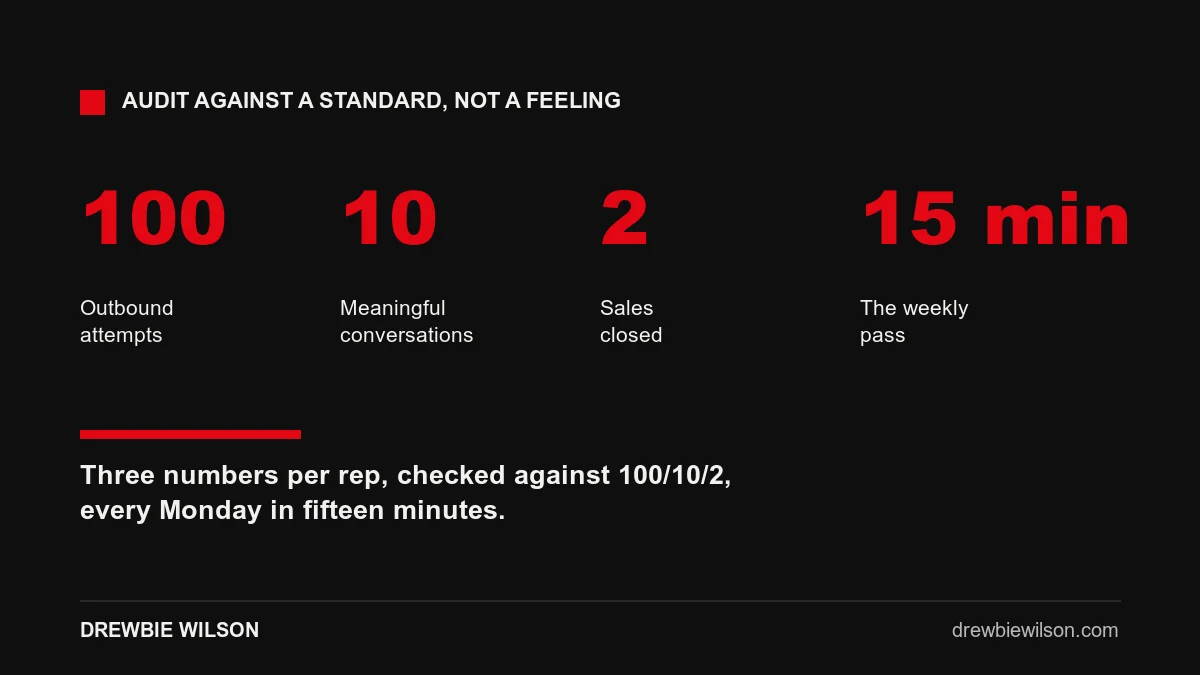
So write the standard down before the first audit. The one I use is the 100/10/2 Standard, a daily standard: 100 outbound attempts, 10 meaningful conversations, 2 sales closed. Scale it for the role, agree it with the team, and put it at the top of the audit sheet. From then on the audit is arithmetic: the rep's number, the standard, the gap. Nobody has to feel anything about it.
Two rules for the standard that save a lot of grief later. First, define attempts the same way for everyone, in writing, and hold the definition for at least a quarter. Second, the standard is a floor, not a ceiling. A rep above it is not a problem to solve, and the audit should say so out loud. Gallup estimates that managers account for at least 70% of the variance in employee engagement, and the fastest way a manager spends that influence badly is to run an audit that only ever finds fault.
Monday, before the pipeline review, with the door closed. Same time every week, because the audit works through repetition, not through one dramatic deep look in March.
That is the whole routine. It does not grade the calls themselves. A sales process audit does that, with a scorecard, twice a year. This is the weekly version that checks the work existed at all, and the two are meant to run as a pair.
A missing activity has three possible readings, and they need three different conversations. Deciding which one you are looking at before you open your mouth is the difference between a manager reps trust and one they route around.
The tell between the first two is the ratio. A rep who is working but not logging has conversations and closes that are too good for the attempts shown. A rep who is not working has every number low together. How many sales calls per day a rep should make covers what the ratios usually look like by role, so you can read your own.
Lead with a question, not the number. The number comes second, and it comes as a fact rather than an accusation. The shape I use fits in four lines.
That last line is the part most managers skip, and it is the part that makes the audit a management routine rather than a weekly complaint. You said you would check, so check. Why leads go cold explains the rep-side habit you are correcting here, and the follow-up system reps should be running is the cadence the "eight touches" line refers to, and its weekly review is the team-level view of this same audit. This post does not re-teach either. It checks that they happened.
Print this, or build it as a saved view. Eight rows, run top to bottom every Monday.
| What to check | Where it lives in the CRM | The number that says it is healthy | What to do when it is not |
|---|---|---|---|
| Attempts per rep, last five days | Activity report, grouped by owner | At or above five days of the agreed daily floor (100/10/2 scaled to the role) | Read the ratio first: not done, or not logged? |
| Conversations per rep | Activities with a two-way outcome or disposition | Roughly 1 in 10 attempts | If attempts are fine and this is low, the opener or the list is the problem |
| Touches before a lead was marked lost | Activity history on lost and stalled leads | At or above the written cadence floor | The follow-up conversation above, on one named lead |
| Promises from last week's pipeline review | Your own notes against the activity log | Every promise has a logged activity within a day of the date | Ask about the one that is missing, before the next review |
| Next steps on open deals | Open opportunities with a dated task or meeting | Every open deal has one | Deals with no next step get asked about first in the review |
| Activities with no note | Activity report, note field empty | Under one in five | A logging habit, not a work problem |
| Closes | Opportunities moved to won | Tracks the ratio over a month, not a week | Do nothing weekly; read it at 30 days |
| Your own check-backs | Your calendar | Every "I will check Friday" was checked | If you skipped it, the audit is theater |
The honest take. If there is no agreed cadence and no agreed floor, the activity log is noise, and auditing noise every Monday makes a manager look busy while the pipeline leaks. The audit only works when there is a written standard to audit against, and most teams that need this post do not have one yet. Writing it down is the first job, and it is a bigger job than it sounds, because it has to survive the first rep who argues with it.
That is what follow-up system training with Drewbie installs: the cadence, the scripts, and the accountability layer that this audit reads from, built with your team so the standard is theirs and not a number handed down. And if the gap is on the manager's side, if the Monday pass keeps getting skipped because nobody taught your managers to run one, sales leadership training is the version of this post delivered to the people who have to do it. Either way, the sales manager CRM activity audit is the fifteen minutes a week that make everything else you bought stick.
If the standard needs a trainer to install it, the sales training vendor evaluation checklist sorts the questions to ask by what you can verify later.
Bring your activity report. You leave with a floor per role, a cadence your reps agreed to, and the Monday routine that checks both.
Get follow-up system trainingSources: Gallup, Why Great Managers Are So Rare · Call The Damn Leads, How to Use a CRM for Sales · Call The Damn Leads, the 100/10/2 outbound sales standard