Are motivational speakers worth it? You would expect a guy who gets paid to stand on stages to say yes and hand you a booking link. I am not going to do that, because the honest answer is: it depends on decisions YOU make before and after the event, more than on whoever holds the microphone.
I have seen a 45-minute talk genuinely reset a sales floor. I have also seen rooms full of people clap, feel great for 48 hours, and change nothing. Same energy, same applause, completely different outcomes. Here is what actually separates the two, so you can decide with your eyes open.
Get clear on the product. A motivational speaker delivers a state change: the room walks in tired or cynical and walks out believing effort is worth it again. Done well, that is not fluff. Belief drives activity, and in sales, activity drives everything.
Here is what a speaker cannot do, no matter what the promo reel implies:
So the question is never "is this speaker good." It is "do we have a job a state change can actually do." Kicking off a new quarter, launching a new standard, pulling a team out of a losing streak, opening a sales kickoff: real jobs. Papering over a leadership problem: not a job, a delay.
| Tier | Typical fee | What you are buying |
|---|---|---|
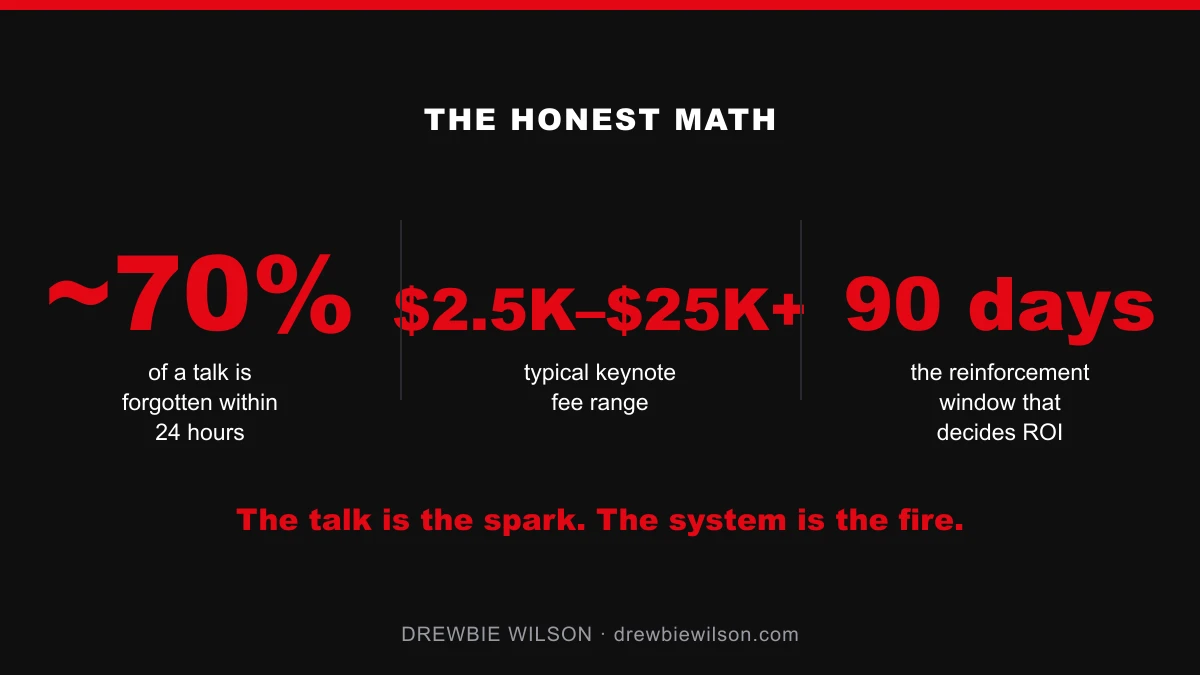
| Local / emerging | $2,500 to $7,500 | Solid delivery, mostly stock talk, light customization |
| Established practitioner | $7,500 to $25,000 | A speaker who has done the job they talk about, custom content, pre-event discovery, tools the team keeps |
| Celebrity name | $25,000 to six figures | Star power and a photo op; behavior change is not the product |
Now the other side of the ledger. A 50-person sales team at even modest quotas represents millions in annual pipeline. If a $10,000 keynote plus real reinforcement moves activity a few percent for one quarter, the math works easily. If the same $10,000 buys 60 minutes of goosebumps and zero follow-through, the math never works. Same check, different outcome, and the difference is not the speaker's fee tier.
One budgeting rule I give every event planner: whatever you spend on the speaker, hold back capacity for the 90 days after. Manager talk tracks, a scoreboard, a weekly cadence. That is where the return actually lives.
That third box is why I keep my own speaking anchored to the systems I still run, the same material on my speaking page at Call The Damn Leads: follow-up discipline, daily standards, picking up the damn phone. Stories open the door. Frameworks are what walk through it.
Real talk: if you are booking a speaker because "we always have one" or because morale is bad and you hope a stranger can fix in an hour what management has not fixed in a year, keep your money. The team will smell it, the glow will fade by Friday, and next year the same talk will work even less. Motivation is a multiplier. It multiplies whatever system it lands on, including zero.
Other waste signals: no discovery call before the event (the speaker is shipping the same talk your competitor heard last month), no takeaway tool the team can use Monday, and nobody assigned to carry the message after the applause. Any one of these can be fixed before you sign. All three together? Walk away.
The forgetting curve is undefeated: memory research going back over a century shows people lose most new information within days unless it gets reinforced. That is not a reason to skip the speaker. It is the reason the speaker is step one of four:
Do those four things and the answer to the worth-it question changes from "hopefully" to "provably."
Worth it when you buy behavior change and treat the talk as ignition. A waste when you buy applause and hope. The speaker matters, the fee tier matters less than you think, and the 90 days afterward matter most of all. Decide the outcome first, vet for substance, plan the echo, measure the behavior. Do that, and yes, a great motivational speaker is one of the highest-return hours you can put in front of a sales team.
And if you want the version where the guy on stage has actually carried a bag, built the systems, and still calls his own damn leads, let's talk.
If the honest answer is that your team is exhausted rather than uninspired, a speaker is the second move, not the first. Start with the fixes that work when the bonus has stopped working, then decide whether you still need the room fired up.
And if the room you are filling is an annual sales kickoff rather than a mid-year reset, the kickoff version of this lays out the agenda slot, the fee range, and the follow-through.
Whoever you book, settle how you will judge the spend before the day. Measuring sales training ROI starts with four numbers you pull the week before anyone takes the stage.
Drewbie brings blue-collar-tested frameworks, a customized talk, and a follow-through plan, whether you need a sales motivational speaker for your next event or full keynote speaking programs.
Work With DrewbieSource: Murre & Dros, "Replication and Analysis of Ebbinghaus' Forgetting Curve" (PLOS ONE)