
Most keynote bookings are a coin flip. The company pays four or five figures, the room claps, everybody eats the chicken lunch, and by Monday nothing has changed. If you are trying to figure out how to choose a keynote speaker for a sales team, the fix is simple: stop shopping for a performance and start shopping for an outcome.
I have sat on both sides of this. I have booked speakers, and I get booked as one. Here is exactly what I would look for if it were my budget on the line.
Every speaker has a highlight reel with big stages, big laughs, and a standing ovation. None of that tells you whether your reps will make one more call on Tuesday.
Before you look at a single video, write down the answer to this: what do we want our people to DO differently after this event? Not feel. Do. More outbound calls. Faster follow-up. Cleaner discovery questions. Pick one.
Gallup pegs worldwide employee engagement at just 23%. That is the real enemy in the room. A keynote is one of the few moments you have the whole team's attention at once, so aim it at a behavior, not at a mood.
There are two kinds of sales keynote speakers: performers and operators. Performers move the room. Operators move the pipeline. You want someone who can do both, and these questions expose the difference fast.
| Performer | Operator | |
|---|---|---|
| Core skill | Working a room | Working a pipeline |
| Stories | Borrowed or generic | From their own deals |
| Customization | Your logo on the deck | Your process in the talk |
| Monday result | "Great speaker" | Reps change one behavior |
A few warning signs show up over and over when a booking goes sideways:
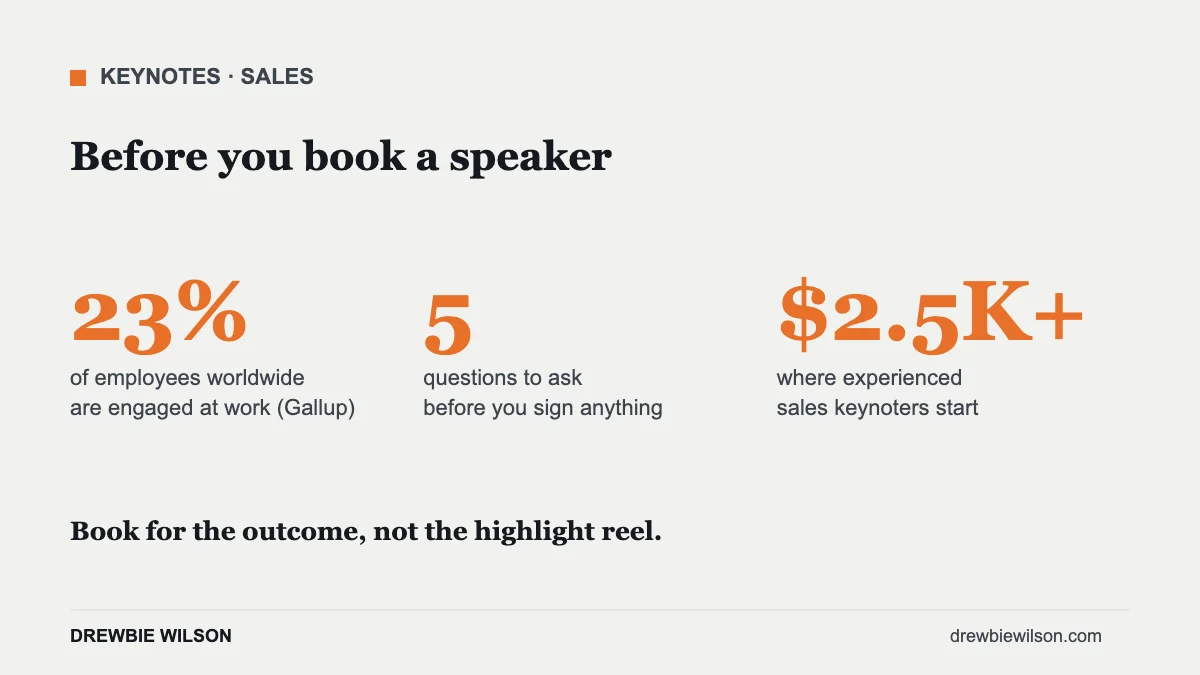
Real numbers, because nobody publishes them. Newer professional speakers with genuine sales chops start around $2,500 to $5,000. Established names with books, a following, and deep customization run $10,000 to $25,000. Celebrity keynoters go well past that, and you are mostly paying for the name on the agenda.
My honest advice: the budget line matters less than the match. A $5,000 operator who studies your team beats a $50,000 celebrity reading a stock speech every single time.
My honest take: if a speaker cannot tell you what your reps will do differently on Tuesday morning, you are buying entertainment, not a keynote. Entertainment is fine. Just do not expect it to show up in the pipeline.
Since you are here, I will show my cards. Every talk I give is built on frameworks my own teams run daily: the C.A.L.L.S. Framework for running better sales conversations, and the 100/10/2 Standard for daily activity. I have personally closed more than $15M in sales, so the stories on stage come from my own deals, not a case study library.
Before any event I run a discovery call, dig into how your team actually sells, and build the talk around the one behavior you need changed. If you want to see how that works, here is where to book a sales keynote speaker who treats your event like a revenue project.
Notice how much of that vetting list comes down to one question: has this person actually built the thing they are teaching? The test cuts both ways. If you are the salesperson buyers are quietly checking out before they reply, you are being vetted on exactly the same terms — which is the whole point of building a personal brand that sources pipeline.
Once you know who to book, the next question is where. Choosing between a virtual and an in-person sales keynote covers the reach, the reinforcement and the travel line that decide it.
If the budget is going to a workshop instead, the same buyer discipline applies. This sales training vendor evaluation checklist turns the vetting into ten questions you can verify after the invoice clears.
Tell me about your event and the behavior you want changed. I will tell you straight whether I am the right fit.
Work With DrewbieSources: Gallup, State of the Global Workplace · National Speakers Association