
You have a budget line for the kickoff and a short list of speakers. The question that stalls the decision is a simple one: why does one quote look so different from the next? A sales keynote speaker fee is not one number plucked from the air. It is a handful of choices, and you control more of them than you think.
This post covers what goes into the fee, which levers you can pull, a real published range, and what to ask for when the quote arrives.
The hour on stage is the smallest part of the work. A fee covers the prep before it, the date held off the speaker's calendar, the travel around it, and the thinking that makes the talk fit your room instead of every room.
Once you see the fee as prep plus date plus travel plus delivery, a quote stops being a mystery and becomes a list you can read. If you are still deciding whether to hire a speaker at all, are motivational speakers worth it makes that case. This post is for the next step, when you are comparing numbers.
Here are the six levers, what each one does to a fee, and how much of it you control.
| Lever | What it does to the fee | What you control |
|---|---|---|
| Date | A date the speaker has to protect from other bookings | Your date, or how flexible you can be around it |
| Format | A keynote, a half-day workshop and a keynote plus workshop are different amounts of work | Which one you are really buying |
| Customization | A talk built around your numbers takes more prep than a standard one | How much you send, and how early |
| Travel | Flights, lodging and time away sit on top of the fee | Venue location, and in person versus virtual |
| Extra sessions | A breakout, a manager session or a second talk adds prep and hours | Whether the agenda needs them |
| Follow-through | Tools, a handoff for managers or a recorded version add work after the stage | What your managers will actually use |
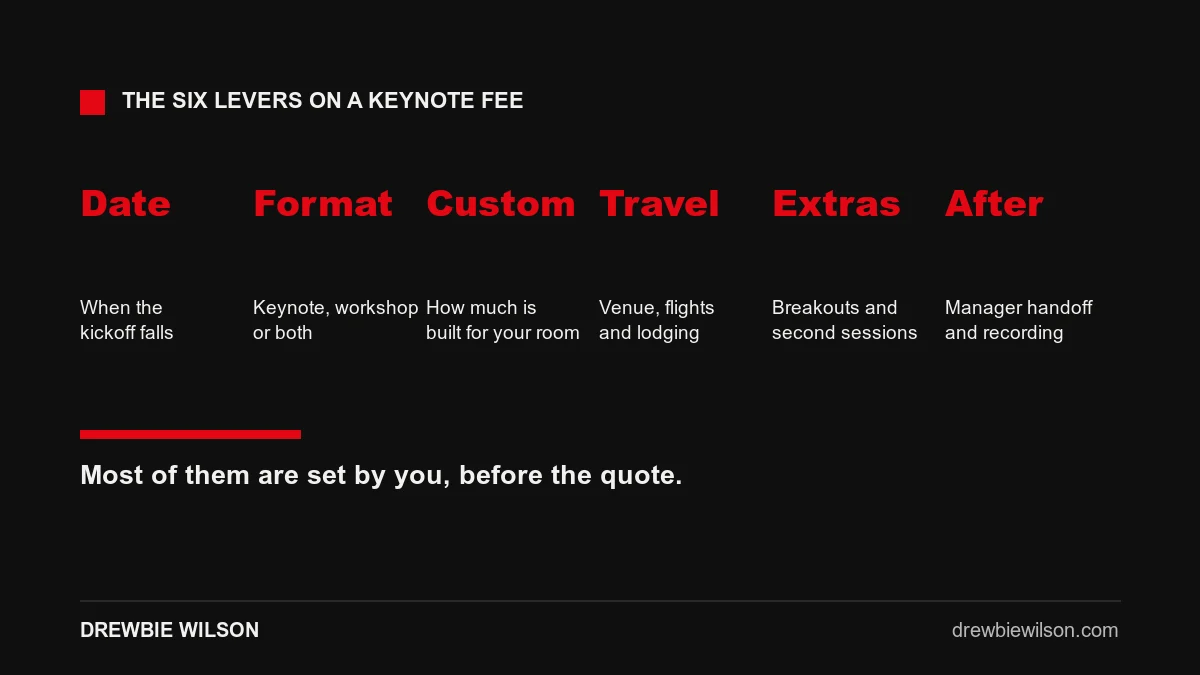
None of these is a trick. Each one maps to hours of work or a day off the calendar, and each one is something you can ask about.
Here is a real number: the one Drewbie publishes for his own work. Keynotes run $2,500 to $7,500 plus travel and lodging, and workshops are quoted separately. Training programs start from $1,000. Final pricing depends on event size, location and format.
Notice what is in that sentence and what is not. It names the range, says travel sits on top, and says workshops are a separate quote. A speaker who can state the range in two sentences should be able to state the line items in two more. If a quote cannot, ask for the lines.
The sales motivational speaker page covers the motivational side of the same fee. For a kickoff, the same six levers apply, and the number depends on the format and the room.
If the number is higher than the budget, three levers matter most, and all three are yours.
The point is to change the ask, not to push the speaker down. Asking for less and getting a lower number is fair. Asking for the same thing at a lower number is a conversation about whether the work will be done.
Bring this list to the first booking call. Each item should come back as a line, a number or a plain yes or no.
A quote that answers all seven fits on one page. If it does not, the missing lines are the questions to ask.
The honest take. The cheapest quote is not the one with the lowest number. It is the one where every line is something you wanted. A low fee that leaves out the prep call and the handoff costs you the thing you were buying the talk for. Price the whole job, not the hour on stage.
A fair number is one you can explain to your finance team in two sentences. The fee buys a talk built from your facts, delivered on your date, with a plan for the week after. If you can say that, and the quote backs it up, the number is fair for your room.
Then test the speaker, not the invoice. How to choose a sales keynote speaker gives the five questions that separate a practitioner from a polished reel. A good answer to the question of what your team will do differently on Monday is worth more than a few hundred dollars either way.
Harvard Business Review's tip Put Your Audience's Needs First When Preparing for a Speech starts with who will be in the room. That is also the right place to start on price: a talk is only worth the fee if it was built for the people who will hear it.
A sales keynote speaker fee is six levers and a short list of lines. Pull the ones that matter, ask for the quote in writing, and pay for the whole job.
Keynotes run $2,500 to $7,500 plus travel and lodging, and workshops are quoted separately. Final pricing depends on your event.
Book DrewbieSources: Harvard Business Review, Put Your Audience's Needs First When Preparing for a Speech · Call The Damn Leads, the 100/10/2 outbound standard