
You signed the speaker. The date is on the calendar and the contract is done. Now comes the part that decides whether the hour sounds like it was written for your team: what you send them. A sales kickoff speaker briefing pack is the set of facts that lets an outside voice talk about your year instead of a generic one.
Below is what goes in, a send-by timeline, the 20 minute pre-call, and what to keep out.
A speaker who has not been told about your team will give a talk that fits any team. It can be a strong talk. It will not mention your product's longest stall, the objection that cost you three deals last quarter, or the fact that half the room joined in August.
Harvard Business Review's tip Put Your Audience's Needs First When Preparing for a Speech says that from the moment you begin to prepare, think about who will be in the room. A speaker can only do that if somebody tells them who is in the room. That is your job, and it comes down to a few short documents sent over eight weeks.
When you choose the person, how to choose a sales keynote speaker covers the questions to ask. This post starts the day you have signed.
Send these as short documents or one page each. A 30 page deck gets skimmed.
If the talk is about prospecting activity, add the standard you want reinforced. The 100/10/2 Standard is a daily floor of 100 outbound attempts, 10 conversations and 2 sales closed. A rep who runs it five days a week is looking at 500 attempts a week, so tell the speaker which of those numbers your team can say today. The origin of the standard is written up on the Call The Damn Leads store.
If the five parts feel like a lot, start with one page. Each line below is a sentence or two.
The last line is the most useful one, and the one that is easiest to skip. If you cannot write it, the talk has no target. Spend an extra ten minutes on it, and share it with the managers who will inspect it. They should hear the ask from you before they hear it from the stage.
Attach anything the speaker can read in five minutes, such as a one page org summary or the agenda draft. Leave out the 40 slide deck from last year's kickoff unless you are asking the speaker to avoid repeating it. The goal is a speaker who walks on knowing your year, not one who has read everything you own.
Every item has an owner and a reply you should expect. Dates count backward from the event.
| Weeks out | What goes to the speaker | Who sends it | What to ask back |
|---|---|---|---|
| 8 | The numbers and the one-sentence objection | Sales leader | What the speaker still needs to know about the year |
| 6 | Who is in the room and last year's event | Event owner | Whether anything in the room changes the format |
| 4 | A draft of the agenda and the pre-call invite | Event owner | The shape of the talk, before the event |
| 2 | Final headcount, venue and tech details | Event owner | A confirmed run of show |
| 1 | The final agenda and one line on the mood of the team this week | Sales leader | Any last request |
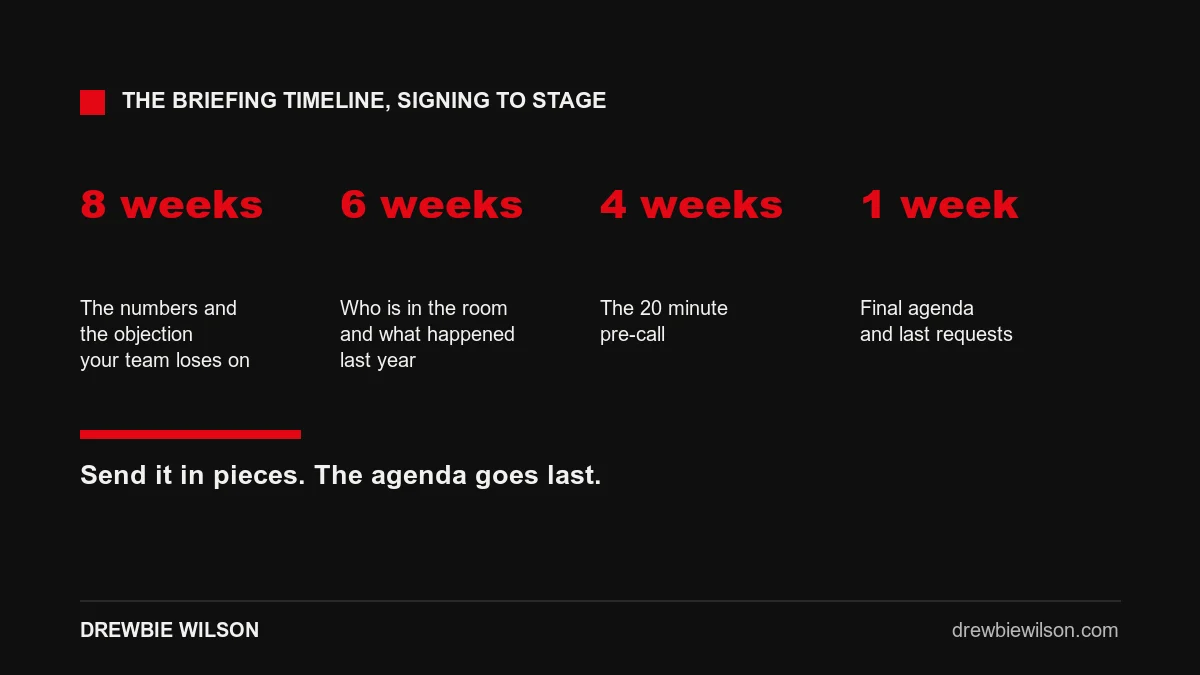
The reason to send in pieces is that you can answer questions as they come up, and your information stays current. The headcount that was true at eight weeks is rarely the one at one week.
Book it around four weeks out, once the speaker has read the numbers. Both sides come with three questions.
The organizer asks the speaker:
The speaker asks the organizer:
Take notes on the second list. The answers are the talk. A sales kickoff speaker who scopes the talk on one call about your year, your number and where deals are stalling is working from the same list.
A briefing should give the speaker the room, not the office. Leave these out:
The honest take. A good briefing has a cost: it takes your time, and it asks you to say out loud what is not working. That is the point. The more specific the pack, the less the talk sounds like a talk, and the more it sounds like your own year said back to you.
Listen to the first five minutes. If the speaker names something only your team would recognize, such as the objection, the stall or the way the year started, the pack landed. If the opening could be delivered to any company in your industry, something was missed, and it is worth asking the speaker what they did not have.
Then look at what happens after the stage. Ask each manager to name the one number from the talk, and give them a place to inspect it. The keynote speaking offer from Drewbie is built the same way: scoped to your team, your motion and where your pipeline is stalling, with a handoff so managers can hold the standard.
A sales kickoff speaker briefing pack is a few short documents and one call, and it is the cheapest improvement you can make to the day. Send the numbers first, hold the pre-call, and keep the politics out.
A kickoff keynote scoped on one call about your year and your number, built from the facts you send.
Book DrewbieSources: Harvard Business Review, Put Your Audience's Needs First When Preparing for a Speech · Call The Damn Leads, the 100/10/2 outbound standard