
Somebody on your leadership team wants a virtual sales keynote because it is cheaper and easier to schedule. Somebody else wants all fifty reps in one hotel ballroom. Both of them are right, and which one is right for you depends entirely on what has to be true by Monday morning.
I have delivered both formats for years, to full rooms and to camera grids spread across the country. I have watched both land and I have watched both flop. So here is the honest way to choose, with no angle on it, because I get booked either way and I would rather you book the one that works.
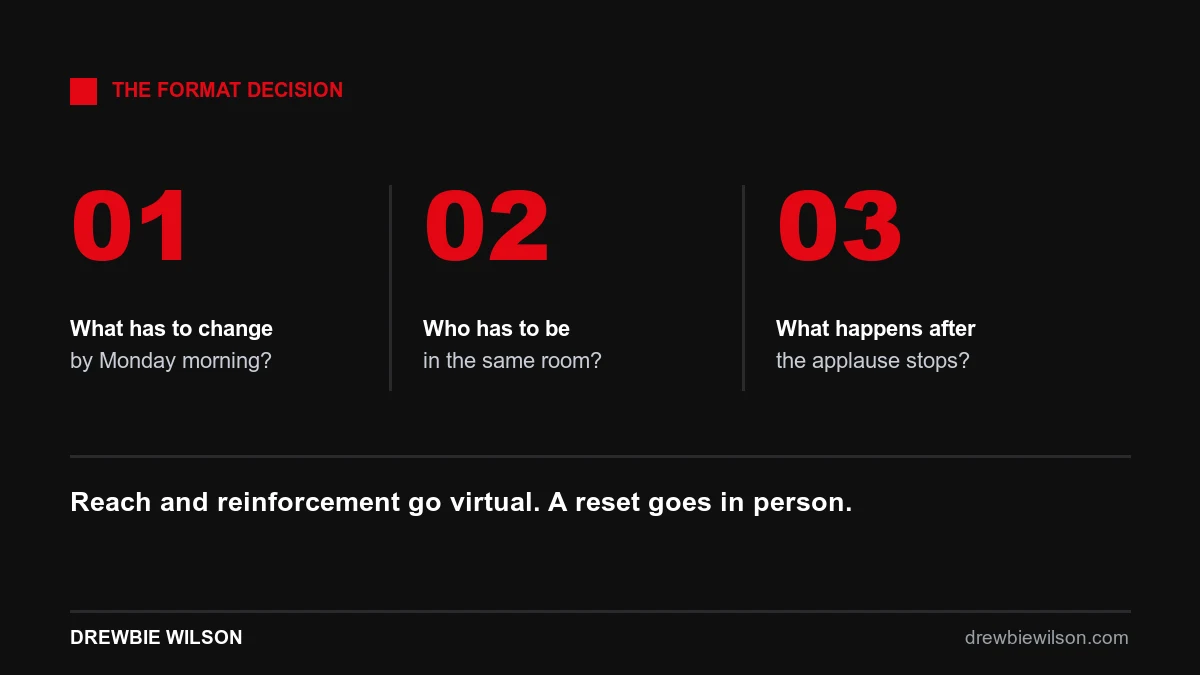
If the goal is reach and reinforcement, virtual wins. If the goal is a reset, in person wins. That is the whole decision, and everything else is logistics.
Reach and reinforcement means you want a specific idea in front of everyone, including the reps nobody would have flown in, and you want it repeated. Information travels fine over a camera. A reset is different. A reset means the team has stopped believing something, or a hard decision has been avoided for two quarters, or two regions have not spoken to each other since the reorg. Belief does not travel over a camera the same way, because half of what changes a room is people watching each other change.
Here is the test, and it takes one minute. Write a single sentence that starts "By Monday morning, this team will..." If the end of that sentence is a habit, a number, or a piece of information, book virtual and spend the savings on reinforcement. If the end of that sentence is about belief, trust, or a decision somebody has been dodging, book the room.
Then two more questions. Who has to be in the same room for this to land? And what happens after the applause stops, because if nothing is on the calendar for the Monday after, the format was never the problem.
Start with who is in the audience. Gallup found that eight in ten remote-capable employees are hybrid or fully remote today, and the same share expect to keep working that way, which means the "whole team" you are trying to reach has not been in one building for years. An in-person event reaches the people whose travel got approved. A virtual one reaches the new SDR in a spare bedroom two time zones away who needs it most.
Three more things virtual does better, and each one is worth real money:
Before you compare a virtual fee with an in-person fee, price the room properly. The GSA publishes the per diem rates federal agencies use for lodging, meals and incidental expenses, with a standard rate covering most of the continental US and individual rates for roughly 300 non-standard areas. Take the lodging and meals rate for your host city, multiply by heads and by nights, add flights and ground transport, and you have the real number the speaker fee is competing against. Most teams discover the talk was never the expensive part.
Energy compounds in a room. When one rep leans forward, the two next to him lean forward. On a camera grid that loop is broken. Everyone is alone, deciding privately whether to care.
The bigger one is the hallway. The real work of a kickoff happens in the twenty minutes after the talk, when a rep who would never raise a hand walks up and asks the question he has been carrying for six months. That conversation does not happen in a chat box. If you book the room, protect that window on purpose: no next session for half an hour, no laptops open, leadership standing in the room and not checking email in the corridor.
In person also produces accountability that survives the week. Gallup's own read on hybrid work lands in the same place from the other direction: the office is still the best place for people to work collaboratively. A keynote that is meant to change how a team behaves together is collaborative work, not a broadcast.
| What you are weighing | Virtual | In person |
|---|---|---|
| Audience reach | Everyone, including the reps who never get flown anywhere | Whoever got travel approved, usually the top and the managers |
| Attention and energy | Has to be engineered every few minutes or it drifts | Compounds on its own once the room is warm |
| Cost drivers | Speaker fee and prep. That is close to the whole list | Speaker fee plus travel, lodging, meals, venue and lost selling days |
| Lead time | Weeks | A quarter, sometimes two for a large kickoff |
| Replay value | High. Record once, use it in onboarding for a year or more | Low. A camera at the back of a ballroom is not a watchable asset |
| What breaks it | Cameras off, no interaction, ninety-minute block | Packed agenda with no gap after the talk for the hallway |
Most virtual events are bad because nobody changed anything except the delivery method. Five fixes, and they are all free:
Run it that way and a remote keynote does the job. If the goal is a multi-week skills program rather than one event, that is a different product, and structured virtual sales training for remote teams is the right line item for it.
Hybrid sounds like the best of both and usually delivers the worst. Two things ruin it, every time.
First, the remote half watches a slide deck and a distant head. One camera at the back of the room shows them nothing. Put a second camera on the audience, so the people at home can see the room react. The reaction is the content.
Second, remote questions never reach the stage. In a hybrid room the energy is in front of the speaker, so chat goes unread. Assign a remote host by name, give that person a live mic, and let them interrupt.
My honest take. If the team has stopped believing the number, do not book a virtual keynote. I have delivered good material to a demoralized team over a camera and watched it slide off. Belief is a room problem. Flat pipeline, post-merger friction, a year where the plan changed three times: those are the weeks to spend the money on flights and get everybody in the same four walls.
The reverse holds too. A quarterly reinforcement, a product launch, a national number that needs restating in front of the people who never travel: those are virtual, and paying for a ballroom to deliver them is a waste of budget you could spend on two more sessions.
Once you know the format, the rest of the booking is straightforward. Pick the human before you pick the room, because the format is a smaller variable than the speaker. If you are still at that stage, work through how to choose a sales keynote speaker first and come back to format after. If you have the human and you are building the run sheet, the keynote topics that hold a sales team will tell you what to ask for, and the kickoff agenda covers the hours either side of the talk.
My own answer, when a VP asks me directly: if this is the meeting where the year gets set, get in the room. If it is any of the other three quarters, a virtual sales keynote does the job, so put me on a camera, give me forty-five minutes and an assignment at the end, and spend the travel budget on coaching. If you want a room lifted rather than a process installed, that is a sales motivational speaker booking and it works in both formats. And if you want me to tell you straight which one your team needs, that conversation is free, and it starts on the sales keynote speaking page.
If the talk you are weighing is about prospecting activity, the outbound sales keynote runs in either format, and the daily number lands the same on a camera as it does in a room.
I run the same material on a stage and over a camera. Tell me the outcome you need and I will tell you which one to book, even when the answer costs me the travel day.
Book a sales keynoteSources: Gallup, The Future of the Office Has Arrived: It's Hybrid · Gallup, The Advantages and Challenges of Hybrid Work · U.S. General Services Administration, Per Diem Rates