
Most guides on sales training roi tell you to establish a baseline, run the training, then compare revenue, win rate and quota attainment before and after. That is the right shape and the wrong order. Revenue is the last thing to move. If your sales cycle is 60 to 90 days, the deals a rep closes in the month after training were mostly opened before the session. Wait for the output numbers and you will either declare victory on deals the training had nothing to do with, or write the whole thing off before it had a chance to show up.
The inputs move first. A rep who learned a better opener on Tuesday will show more conversations per 100 attempts by Friday. A team that installed a written follow-up cadence will show more touches per lead within a week. Those are the numbers I would measure, and I would pick them before anyone books a room.
The standard ROI approach starts at the end of the funnel. Pull last quarter's revenue, run the training, pull this quarter's revenue, subtract, divide by the cost. It is clean on a slide and useless in practice, for three reasons.
Inputs solve all three. They move within days, they are per rep so one big deal cannot hide a team that stopped dialing, and when one is flat you know exactly which behavior to go look at. This is the same logic behind the 100/10/2 Standard: 100 outbound attempts, 10 meaningful conversations, 2 sales closed. Those are the daily inputs, and they are the units a training session has to move.
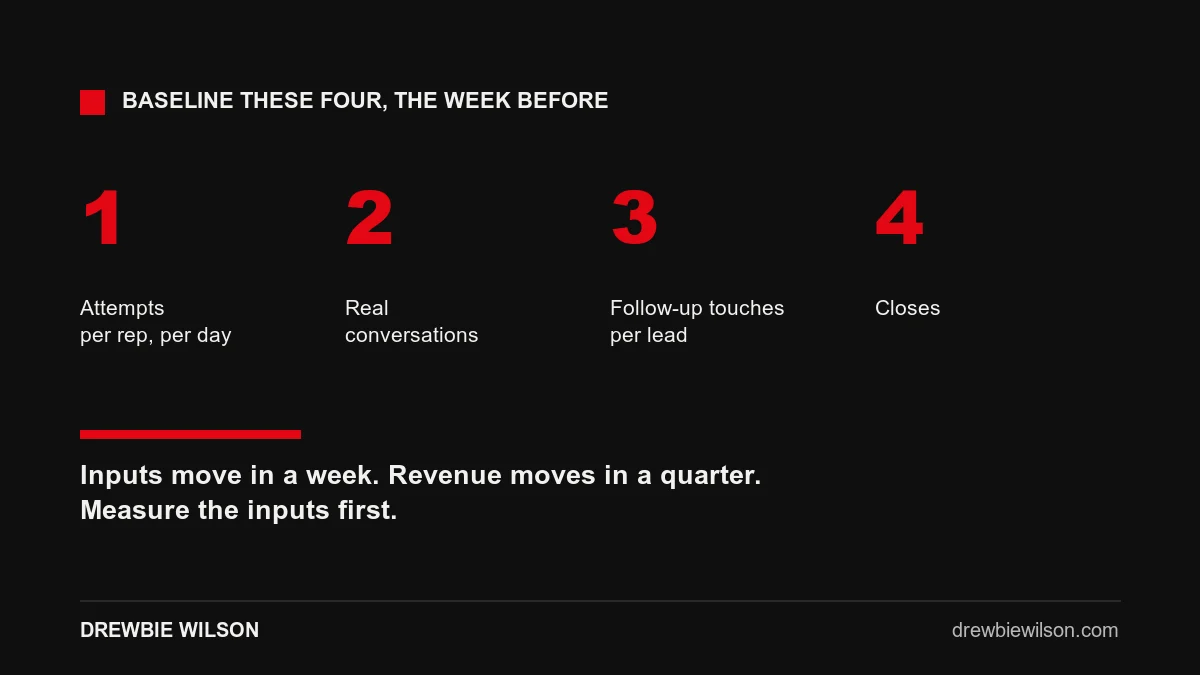
Pull these per rep, per day, for the five working days before the training. Do not average them into a team number yet. You want to see who was short on what.
If your CRM cannot produce these four in an afternoon, that is the first finding of the whole exercise. The training will not be measurable until it can, and no trainer can fix that from a stage. A sales process audit walks through the full pull if you want the longer version.
Run the training. Then do nothing to the measurement for 30 days except keep the definitions the same. On day 30, pull the same four numbers for the most recent five working days and set them beside the baseline, rep by rep.
The one spreadsheet column that matters is the change in the number the training was supposed to move. If the session was about openers, conversations per 100 attempts is the column. If it was about follow-up, touches per lead before a rep stops is the column. If it was about closing, the share of conversations that end with a booked next step is the column. Everything else is context.
Three outcomes, and what each one means:
Use this to decide, before the session, what you will pull and when.
| Metric | Type | When it moves | How to capture it | What "no change" means |
|---|---|---|---|---|
| Attempts per rep per day | Input | Days | CRM activity report, one row per rep | Reps are not doing more, whatever they learned |
| Conversations per 100 attempts | Input | One to two weeks | Conversations logged divided by attempts | The opener or the list did not change |
| Follow-up touches per lead | Input | One to two weeks | Touches on leads marked lost or stalled | The cadence is not being run |
| Next steps booked per conversation | Input | Two to four weeks | Conversations that end with a dated meeting | The ask is not being made |
| Closes and win rate | Output | One sales cycle or more | Won deals, won divided by closed | Too early to tell, or the inputs never moved |
| Revenue per rep | Output | One to two quarters | Booked revenue by owner | Same as above, plus market noise |
The formula itself is not the hard part. ROI equals the gain from the training minus its cost, divided by the cost. The hard part is what you are allowed to put in the gain, and the honest answer is: only the revenue you can trace to an input that moved.
A worked example, with made-up round numbers so the arithmetic is visible. A team of eight reps averaged 8 conversations per 100 attempts before a session on openers and 11 after. At their usual attempt volume that is about 30 more conversations a week across the team. Their historical rate of one close per 12 conversations puts that at roughly 2.5 extra closes a week. If an average deal is worth $2,000, that is about $5,000 a week in new revenue that traces straight to a number the training moved. Against a training cost of a few thousand dollars, the return is visible within the first month, and it is built on a change you measured rather than a quarter you hoped for.
Swap in your own conversation rate, your own close ratio and your own deal size. The point is the chain: input moved, ratio held, output follows. If the input did not move, there is no chain, and no formula will rescue it.
One question does most of the work: which of my four numbers does your session move, and how will we both know 30 days later? A trainer who has done this before will name the number without thinking. A trainer who answers with "energy," "mindset" or "confidence" is describing a keynote, which has its own place and its own return, covered in whether motivational speakers are worth it.
Three more that separate training from a nice day out:
The honest take. A clean before and after that shows no movement is usually not a verdict on the trainer. It is a verdict on the four weeks after. Gallup puts 70% of the variance in team engagement on the manager, and on a sales floor the manager is also the only person positioned to check, week by week, whether the new behavior is still happening. If nobody did, the number went back to baseline by week two and the day-30 pull just confirmed it. That is why sales leadership training for the managers running the floor is often the higher-return purchase, and why the best time to buy it is before the rep training, not after it failed.
Once you know which input is short and have the baseline pulled, the training itself is the straightforward part. That is how Drewbie's sales team training is built: the C.A.L.L.S. framework and the follow-up system behind $15M+ in personal sales, delivered to the number your team is short on. Run the 30-day re-pull yourself and it is the scorecard. Measured that way, sales training roi stops being a slide you build afterward and becomes the reason you booked the session in the first place.
Measuring the result is half the job. The other half is choosing the vendor, and this vendor evaluation checklist for sales training sorts the questions you ask before you sign by what you can verify at day 90.
Bring your baseline, or bring the CRM export and we pull it together. You leave knowing which number a session should move and what it should read on day 30.
Get sales team trainingSources: Gallup, How to Improve Employee Engagement in the Workplace · Call The Damn Leads, the 100/10/2 outbound sales standard