
Most of what comes up when you search for a sales training vendor evaluation checklist was written for buying software, or by a training company describing itself. Neither tells you the one thing a buyer needs: how to know, three months after the invoice clears, whether the thing you bought did anything. I sell training, so these are the questions I would want a buyer to ask me. The checklist below is the one I wish every buyer brought to the first call, because it makes the good vendors look better and the weak ones run out of answers by question four.
One rule: a question goes on the list only if the answer can be checked later against something you can count. That cuts the usual twenty-question scorecard to ten and changes the order you ask them in.
Federal buyers have a rule for evaluating proposals that private buyers would do well to copy. Under FAR 15.305, evaluators assess proposals "solely on the factors and subfactors specified in the solicitation," and the strengths and deficiencies behind the decision have to be documented. Decide the factors first. Score against those factors only. Write down why.
Software checklists manage that, because software has features you can test in a demo. Training has no demo. What you are buying is a change in what eight or eighty people do on a Tuesday six weeks from now, and no slide deck can show you that. So the factors have to be things you can observe later, in your own CRM, in your own call recordings, in your own pipeline. A question like "do they align with our culture" fails that test. A question like "which number on my activity report will be different on day 30" passes it.
Ten questions follow. The first five are about what happens after the session, because that is where the money is made or lost.
The gap between a training day that worked and one that did not is almost never the day itself. It is the four to twelve weeks that follow, when reps either keep doing the new thing or drift back. Gallup finds the manager or team leader alone accounts for 70% of the variance in team engagement. On a sales floor, that makes the manager the one who decides whether the new habit survives the month.
So the first three questions are about the manager, not the reps.
A trainer who has done this before will answer all three without pausing. The ones who have not will talk about energy, mindset and culture, which are the words of a keynote. A keynote has its own place and its own return, and choosing a sales keynote speaker is a different checklist for a different purchase. Do not buy one when you meant to buy the other.
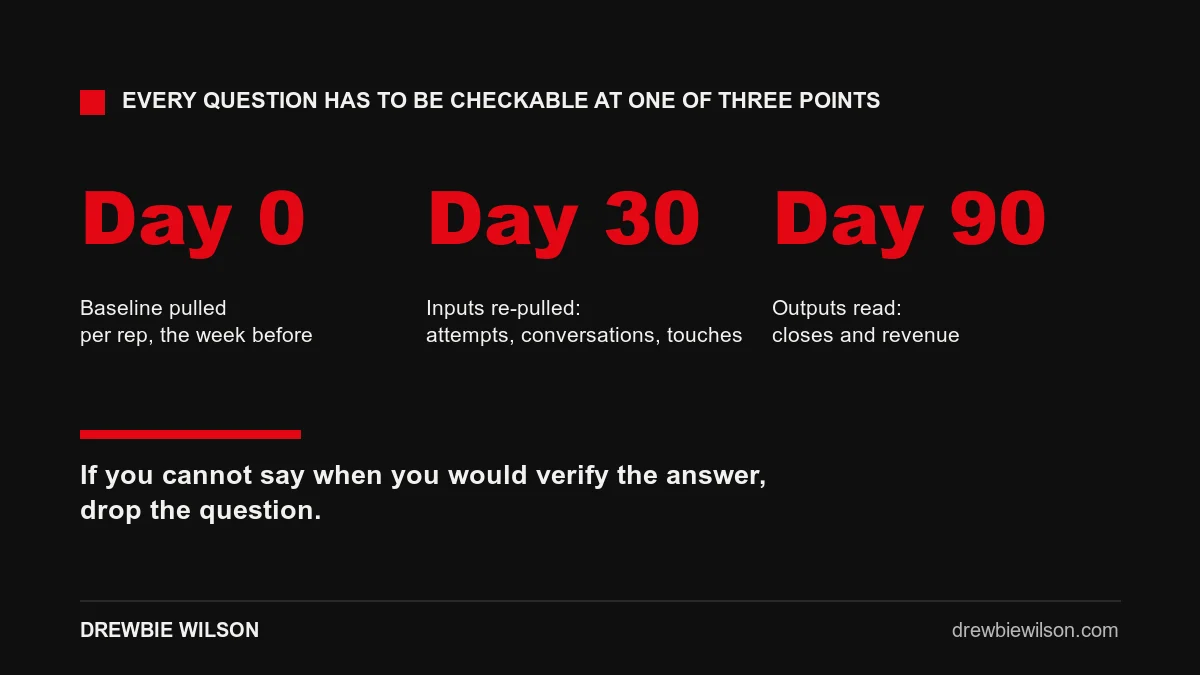
Question four is the one that does most of the work on the whole sales training vendor evaluation checklist: name the one number on my activity report this session changes, and what it should read on day 30.
The useful answers are inputs. Attempts per rep per day. Real conversations per hundred attempts. Follow-up touches per lead before a rep stops. Conversations that end with a dated next step. Those move within a week or two of a session that worked. Two of them, attempts and conversations, are the units the 100/10/2 Standard is built from: 100 outbound attempts, 10 meaningful conversations, 2 sales closed. Revenue and win rate are real outcomes, but they lag a full sales cycle, and by then six other things have changed too.
Question five follows from it: will you help us pull the baseline before day one? The baseline is the week-before numbers, per rep, for whichever input the session targets. Without it there is no before, so there can be no after. A vendor who wants the baseline is a vendor who expects to be measured. One who waves it off is telling you something. How to measure sales training ROI walks through the four numbers and the 30-day re-pull if you want the measurement side in full.
Three questions about the session itself, and all three are checkable on the day.
Two more that belong on the list, because they catch the mismatch that a glossy proposal hides.
The ten questions in one table, in the order to ask them. The third column is the point of the whole exercise. If you cannot fill it in for a question, drop the question.
| Question | What a good answer sounds like | How you verify it later | What a weak answer signals |
|---|---|---|---|
| What does my manager do in weeks 2 to 4? | Two named numbers inspected every Monday, two calls reviewed a week | Manager's calendar and notes at day 30 | Reinforcement is a PDF; the number fades by week two |
| Who owns reinforcement? | A name, on their side or ours | That person's weekly output at day 30 | "Both" means nobody |
| Is the manager in the room? | Yes, as a participant | Attendance on the day | Vendor sees training as a rep event |
| Which number does the session move? | One input, named: conversations per 100 attempts, touches per lead | Same number re-pulled at day 30 | "Energy" and "mindset", no number named |
| Will you help pull the baseline? | Yes, the week before, per rep | The baseline exists before day one | Vendor does not expect to be measured |
| Who delivers, and is it you? | The deliverer is on the call and has run this for teams like ours | Who walks in on the day | Sold by one person, delivered by a stranger |
| How much of the day is live practice? | More than half, on our deals and our CRM | Activity logged in the CRM during the session | A lecture with a workbook |
| Can we watch twenty unedited minutes? | Yes | You watched them | Only a highlight reel exists |
| What will you not do? | A specific list | Whether those limits were honored | Vendor has not thought about your team |
| Have you told a buyer not to hire you? | Yes, with the story | How they behave at a flat day 30 | They will take any engagement |
Write them down, on the call, in the vendor's words. Then score each one against the third column before the proposal arrives, not after. The proposal is written to pass a checklist, and the call is where the vendor forgot to be careful.
Three outcomes, and what to do with each.
A vendor who audits your process first is a good sign, and a sales process audit is what that should look like. One who wants to start on day one without a baseline has answered question five for you.
The honest take. A vendor can answer all ten questions well and the training can still fade, because the ninety days belong to you, not to them. If your managers are not inspecting the numbers weekly, no trainer fixes that from a stage, and the first thing a good one will tell you is that the managers need the work first. That is why sales leadership training for the managers who run the floor often comes before rep training, and why it is the higher-return purchase when the two are competing for one budget.
Once the managers are set up to inspect, the rep training has something to stand on. Drewbie's sales team training is where your team masters the C.A.L.L.S. framework and the exact process behind $15M+ in personal sales, in hands-on sessions with live practice and real scripts, built around your stack, your motion and your goals. Bring the sales training vendor evaluation checklist to your first call with Drewbie's team too. It should pass.
After the vendor is chosen, the managers still have to check the work lands. The sales manager CRM activity audit is the fifteen-minute weekly pass that shows whether the follow-up happened.
Bring the checklist. You will get a named number, a baseline plan and a straight answer on what the training will not do, in one call.
Ask about sales team trainingSources: Federal Acquisition Regulation 15.305, Proposal evaluation · Gallup, How to Improve Employee Engagement in the Workplace · Call The Damn Leads, the 100/10/2 outbound sales standard