
Kickoff dates get set early and the speaker question can land late. The venue gets booked, the product team asks for a slot, and by the time someone says "we need a speaker" the date can be six weeks away. The usual advice for a sales kickoff speaker booking timeline is to book six to twelve months out, and that advice is fine. It just does not help you today.
This post is for the planner who is closer to six weeks than six months: what is still realistic, what to cut, and the countdown that gets a speaker confirmed.
The clock the organizer sees is the event date. The clock the speaker sees is a calendar with other dates on it. Those two clocks rarely match, and that is where a late booking gets tight.
A few things can push the speaker decision late: an agenda that waits on a product launch, budget sign-off that arrives after the venue is held, or one person running both the logistics and the speaker slot. None of that is a failure, and it is why the late half of the timeline deserves a plan of its own.
The early booking case is simple. You get the widest choice of speakers and dates, time for a proper briefing, and room to build the talk around your year. If you are reading this at that stage, do it: pick the speaker, hold the date, and send the briefing pack in pieces over the weeks that follow.
Everything below is for when that window has already closed.
Use this table to decide how much to attempt. What is realistic always depends on the speaker's calendar, so treat the middle column as a planning guide, then confirm it on the first call.
| Weeks out | What is realistic | What to cut | What to do this week |
|---|---|---|---|
| 26 or more | Full choice of speakers and dates, a custom talk, a workshop attached | Nothing | Shortlist and hold the date |
| 12 to 25 | A custom talk with a full briefing and a pre-call | Anything that needs a long lead, such as printed material | Sign and send the numbers |
| 8 to 11 | A talk shaped around your year, one pre-call, a manager handoff | A second custom session | Confirm the date and the slot |
| 6 to 7 | A talk built on your numbers and one objection, with a pre-call | Breakouts, custom handouts, extra rehearsal | Send the numbers first, then the room and last year the following week |
| Under 6 | A strong version of a tested talk, tuned on one call | Most customization, long agenda slots | Ask which dates and formats are still open |
Read the table from your own row down, not from the top. If you are at seven weeks, the six to seven row tells you what you will be cutting a week from now, so you can decide today which extras are worth fighting for. If you have to choose, keep the pre-call and drop an extra.
The pattern is the same in every row. As the weeks shrink, you give up scope and keep the part that makes the talk yours: your numbers, your room and one call with the speaker.
If you are at six weeks, follow this order. Each week has one owner so nothing waits on a meeting.
If one person owns both the logistics and the speaker, the order still holds. Do the week 6 and week 5 sends together on the same day, and put the pre-call in the calendar before you do anything else. A booked 20 minutes in week 4 is the item to protect first, because the rest of the list depends on it.
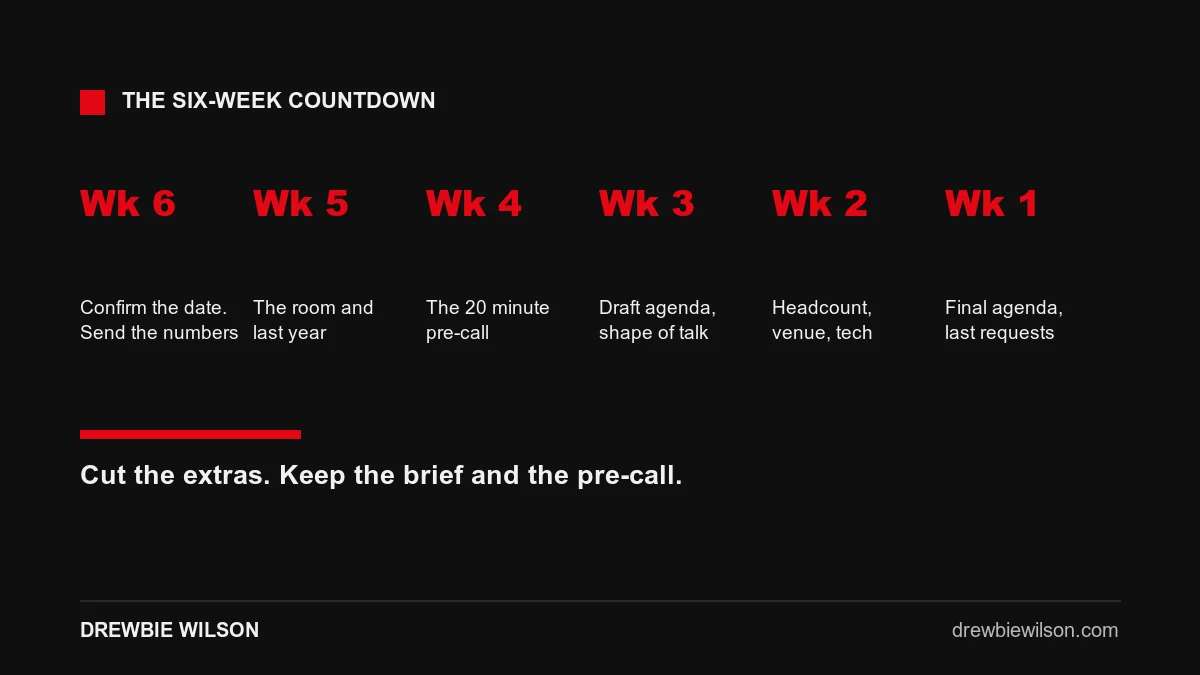
The same steps run on an eight week clock in what to send a keynote speaker before they walk onto your stage. At six weeks, the numbers and the room go out a week apart instead of two.
A short runway costs three things, and it is better to name them early.
It does not cost you the pre-call, the briefing or the result. Those are decided by what you send and when, and both fit inside six weeks. A short runway with a strong brief beats a long one with a blank page.
The honest take. A late booking cannot be undone, but it can be managed. Cut the scope instead of the preparation. A smaller talk built on your real numbers will beat a bigger one that arrives cold.
The fastest way to a yes is a first message that answers the speaker's opening questions before they ask them. Keep it to five lines:
Everything else follows in pieces. The five parts of the full brief, and when each one goes out, are laid out in the briefing pack post linked above. If the talk is built around a daily standard, name it, such as the 100/10/2 Standard, whose origin is written up on the Call The Damn Leads store.
Once the speaker is confirmed, plan the week after the stage as carefully as the week before it. The Monday after the kickoff covers who owns each day of the first week. And if you are still comparing speakers, how to choose a sales keynote speaker has the five questions to ask. For a short runway, look for a speaker who can scope the talk from one call. The sales kickoff speaker page shows how that works, and Drewbie's keynote speaking offer is built the same way.
The sales kickoff speaker booking timeline does not end at six weeks. It just gets smaller: fewer extras, the same brief, and a first email that goes out today.
Keynote, half-day workshop or both, tailored to your event. Tell Drewbie the date and the room, and the talk is scoped from there.
Book DrewbieSources: Call The Damn Leads, the 100/10/2 outbound standard