
The ballroom empties, the flights get booked, and the room that was fired up on Thursday is back in the same inbox on Monday. Sales kickoff follow through after the event is the part nobody schedules, which is why it is the part that decides whether the keynote was a line item or an investment.
This post gives you the first week as a dated table, the 20 minute huddle in words, a week-three check-in, and the questions to put to your speaker before you sign.
Nothing is wrong with the reps. They land back on live deals, a full inbox and a quota with a month already running. Urgency belongs to whatever is in front of them, and the kickoff is no longer in front of them.
Harvard Business Review's More Training Won't Solve Your Company's Problems describes the go-to response to organizational issues as a three-step mantra: design the training, deliver it, move on. A kickoff is easy to run the same way. The event is the deliverable, so when it ends the project feels finished.
It is not finished. The talk set a standard in front of everyone at once. What happens in the next five working days decides whether anyone is held to it.
Reinforcement needs something countable, and one thing is easier to count than five. Before the event, choose the single behavior the manager will inspect the following week. Write it in a sentence a rep can say back.
If the keynote is about outbound activity, the floor is the 100/10/2 Standard: 100 outbound attempts, 10 conversations and 2 sales closed, every day. It is a daily number, so the manager checks it at the end of every day, not once a week. The origin of the standard is written up on the Call The Damn Leads store.
If the talk is about something else, such as follow-up or second meetings, pick the matching count: touches logged, meetings booked, next steps dated. The rule is the same either way. Whatever you choose, tell your speaker, so the number on stage and the number on the manager's dashboard are one number.
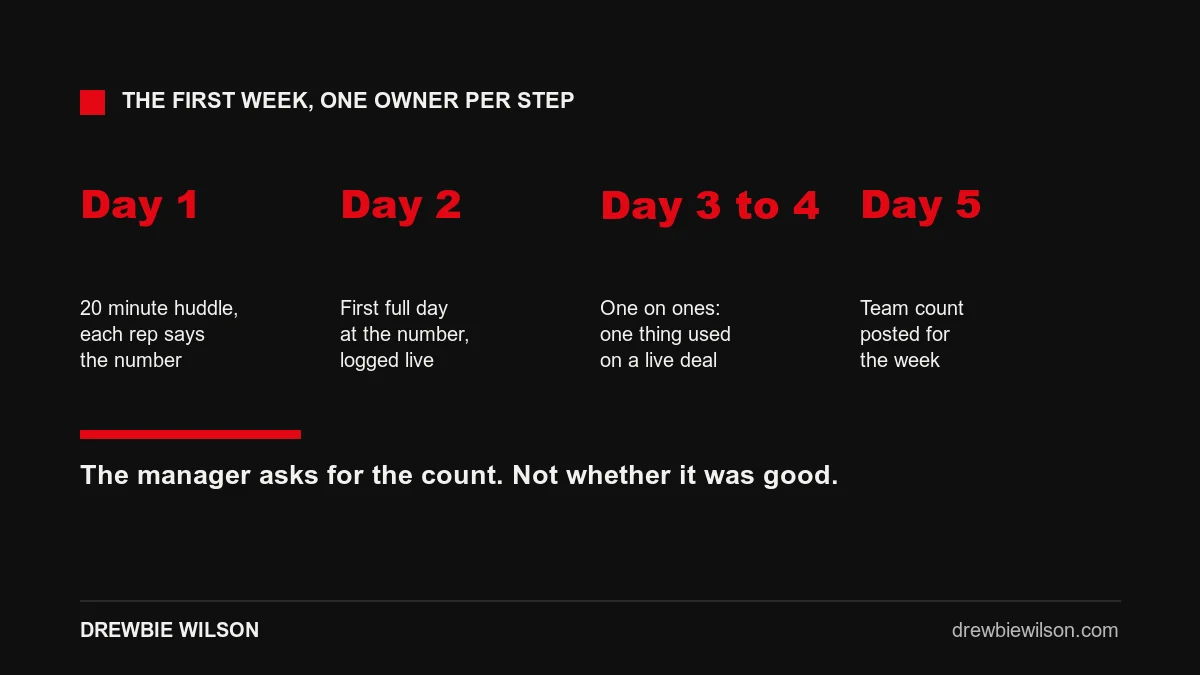
Here is the whole week as a table. Day 1 is the first day the team is back at work, whatever the calendar says. Every row has one owner, and every row has one thing to inspect.
| Day | Owner | What to do | What to inspect |
|---|---|---|---|
| Day 1 | Front line manager | Run a 20 minute huddle. Every rep says the number out loud and writes it where they will see it | Can each rep repeat the number without looking it up? |
| Day 2 | Each rep | First full day at the number, logged as it happens | The count at end of day, against the floor |
| Day 3 and 4 | Front line manager | Ten minute one on one with half the team each day: one thing from the talk used on a live deal | A specific call or email, not a general answer |
| Day 5 | Sales leader | Post the team's count for the week and one example from a rep, in the channel the team already reads | Who is at the floor and who is not yet |
| Next Monday | Front line manager | Same huddle, same count, one new example from a rep | Whether the number moved or only the talk about it |
Notice what is missing: a survey. Asking reps whether they enjoyed the keynote gets you a compliment. Asking for the count gets you the truth, and it is the same ask every day, which is the point.
The Day 1 huddle is the most important meeting of the week and the shortest. It runs the same way every time, and the manager runs it, not the sales leader and not the speaker.
The point is not a perfect huddle. It is that the first thing that happens after the kickoff is a manager asking for a number, on a day when everyone remembers what was said on stage.
A rhythm for the weeks after this one is in the 90 days after sales training and who owns them. That post covers a training program. This one covers the first week after a keynote, so you can use both without repeating either.
After the first week, keep the Monday huddle and add one thing: a check-in in week three. By then the novelty is gone and the old habits are back, so the count tells you who actually took the standard on.
Who runs it: the front line manager, one on one, 15 minutes. Ask the rep three things. What is your count for the last ten working days? Which part of the talk did you use on a real deal? What is getting in the way?
A miss is specific. A rep who is under the floor for ten working days with no explanation they can name is a miss. A rep who is under it because a territory change moved their accounts is not, and the manager should say so. Treat the first as a coaching conversation about the daily number, and the second as a problem to fix.
The honest take. A keynote can reset the standard and get the room to agree to it out loud. It cannot be the person who checks on Tuesday. Your managers hold the standard, and this plan gives them a short, dated way to do it. If you are planning the next event, sales kickoff ideas and themes covers what to build the agenda around, before the follow through begins.
At day 30, put one question to the team: did the number move? If you were already running a weekly activity review, the sales manager CRM activity audit gives you three numbers to check in fifteen minutes.
You are buying a talk and, if you ask, a handoff. Ask these before the contract is signed, so you know what the day-after plan has to cover on its own.
A sales kickoff speaker who builds the talk around your motion and hands managers the inspection format gives the first week something to stand on. The same plan works for any keynote booking, and the keynote speaking page covers the other formats.
Sales kickoff follow through after the event is simple to say and hard to do, because it is management work. Pick the number, assign the days, and run the week-three check-in.
A keynote or half-day workshop built on your deal sizes and your real objections, with the inspection questions and the weekly rhythm handed to your managers.
Book DrewbieSources: Harvard Business Review, More Training Won't Solve Your Company's Problems · Call The Damn Leads, the 100/10/2 outbound standard