

Last month you were comparing numbers with the people on the call. This month you are the one who sets the number. Managing reps who were your peers is the hardest first assignment in sales leadership, because every rep on the team already has an opinion about you, and some of them applied for your job.
This post gives you the first conversation in words, the one you need with the top seller who wanted the title, and a plan for the first 30 days that ends with a standard the whole team can see.
Your friends on the team did not change. What changed is what they are watching for. The rep who sat next to you is now asking three private questions: will this person play favorites, will they keep the rules they used to bend, and will they protect me or the number?
You will not answer those questions with a speech. You answer them with how you act in the first month, and the cheapest place to start is saying out loud that things are different. A manager who pretends nothing has changed looks either clueless or nervous. One who names it looks like the person who has already thought about it.
Harvard Business Review's What to Do First When Managing Former Peers advises meeting one on one with each member of the team, which lets you personalize the message and be more candid than you can be in a group setting. That is the spine of this plan.
Book 30 minutes with each rep in the first week, starting with the people you were closest to, not the ones you are most worried about. Closest first sends the signal that friendship does not buy a later slot. Open with something like this:
"You know I was doing your job a few weeks ago, so this is a little strange for both of us. Here is what will not change: I still want you to win. Here is what will: I now see everyone's numbers, and I will hold everyone to the same standard, including me. I want to hear what you need from me, and what you would want me to stop doing."
Then stop talking. Ask what the rep wants to be known for on this team in a year, and what has been getting in the way. Take notes. You are not solving anything in this conversation. You are showing that the first thing you do with authority is listen, which is the Ask and Listen steps of the C.A.L.L.S. framework pointed at your own team.
End by asking for one specific piece of help in an area where that rep is strong. The same HBR piece recommends asking for specific help in areas where individuals can add value. It turns a rep who might resist you into a rep with a stake in how this goes.
One person on the team usually does not need the speech. They are the top seller, they wanted the title, and they are watching to see whether you are good at it. Treat that conversation separately, and have it in the first week as well.
Ask three questions, in this order:
Then make one commitment you can keep. It could be that you will bring them into decisions on pipeline process before they happen, or that you will ask for their input on new-hire ramp. Pick something small, put a date on it, and do it. A top seller who sees one promise kept in two weeks starts to give you the benefit of the doubt on everything else.
Do not promise a promotion path you do not control, and do not hand them tasks that turn them into your assistant. They will notice both.
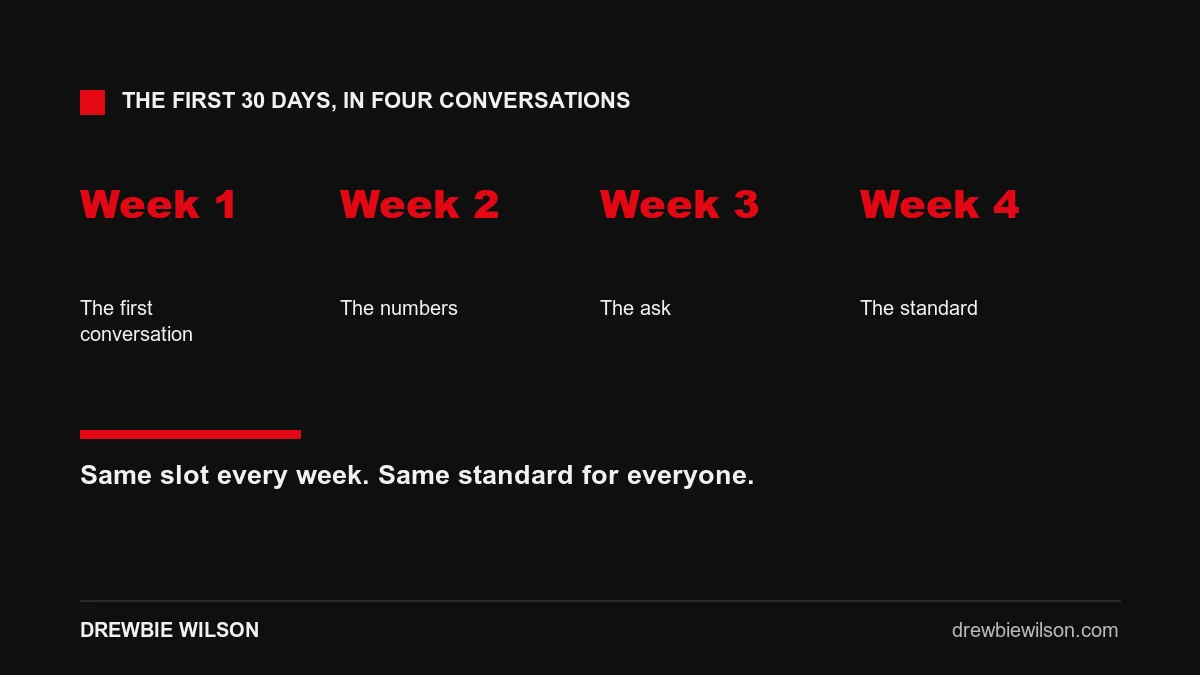
After the first week the plan is simple: four conversations with every rep, one per week, each with a purpose. Hold them in the same slot every week, so the meeting stops being an event.
| Week | Conversation | What to say | What to watch for |
|---|---|---|---|
| 1 | The first conversation | Name the change, say what stays the same, ask what they need | Whether the rep opens up or gives you the polite answer |
| 2 | The numbers | "Here are the numbers I will look at with you every week, and why" | Defensiveness about activity versus results; who volunteers their own gaps |
| 3 | The ask | "Here is where I want your help on the team, and here is what I will take off your plate" | Whether the rep says yes and follows through, or agrees and drifts |
| 4 | The standard | "Here is what good looks like for this role, and I hold the same one for everyone" | Whether the standard lands as fair, and who tests it first |
Week two is where managers usually flinch. Looking at a former peer's numbers is uncomfortable, so the temptation is to skip the conversation or soften it. Do it anyway, and pick the metric before the meeting. If the team has a daily activity standard, that is the one to inspect first, because activity is what the rep controls. The 100/10/2 Standard is the number Drewbie teaches: 100 attempts, 10 conversations and 2 sales closed, every day.
By week four you should be able to state the team standard in two sentences, and every rep should have heard it from you once. If you also run a weekly review of what reps log, the method in the sales manager CRM activity audit gives you the three numbers to check without turning it into surveillance.
Some habits that were fine as a peer are a problem as a manager. Stop these on the first day:
You can stay friendly. You cannot stay a teammate in the way you were. The team will forgive the distance faster than they will forgive uneven treatment.
If you coach SDRs and AEs on a weekly rhythm, what to coach each week for SDRs and AEs picks up where this plan ends. For the larger program around it, sales leadership training from Drewbie covers pipeline reviews, daily coaching and activity standards for managers who carry the number, and sales team training brings the reps into the same standard.
The honest take. Some of this will not work with every person. A rep who agreed to the standard in week four and misses it in week eight is not confused about the standard. That is a performance conversation, and it follows the same rule as the rest of the plan: the same conversation you would have with anyone else on the team.
At day 60, run a simple test. For each former peer, ask whether you would have this conversation with a rep you had hired from outside. If the answer is no, you are still managing a friendship. Move that rep onto the same footing as everyone else, starting with the 100/10/2 numbers and the weekly slot.
And ask yourself one honest question about the top seller. Are they engaged or waiting you out? If they are engaged, give them more of what they asked for in week one. If they are waiting you out, say it directly and keep the commitments you made. The decision after that is theirs.
Sales leadership training for managers who carry the number: pipeline reviews, daily coaching and activity standards, built around your team structure, your metrics, and your sales motion.
Get sales leadership trainingSources: Harvard Business Review, What to Do First When Managing Former Peers · Harvard Business Review, How to Handle the Transition from Peer to Boss