
A sales team spread from the East Coast to the West Coast has a scheduling problem before it has a training problem. Somebody ends up on at 8 in the morning, somebody else well into the evening, and the usual answer is to record the session and send the link. Everyone gets the content. Almost nobody gets the practice.
This post is about running sales training across time zones live, so reps still get reps. It assumes you have already decided on a virtual format. If you have not, virtual vs in-person sales keynotes walks through that choice first.
A recording is a fine way to deliver an idea. It is a poor way to build a skill. Selling is spoken, and a skill that is spoken gets built by speaking it, hearing a response, and trying again.
Watching a replay of a good objection response teaches a rep what the response sounds like. It does not teach them what it feels like to say it to a skeptical person on a Thursday. That part needs a live partner, a trainer who can say "try that again," and a few minutes where the rep is slightly uncomfortable.
So keep the recording, but give it a narrow job. It serves the rep who was on a plane, or sick, or in a customer meeting. It is never a substitute for the practice itself. Write that rule into the schedule: anyone who misses a live block makes it up in a short live make-up slot, not by watching the replay alone.
Start with a simple list: each rep, their local time zone, and the hours they actually work, not the hours on the contract. Convert them all to one clock and look for the longest stretch where everyone is on.
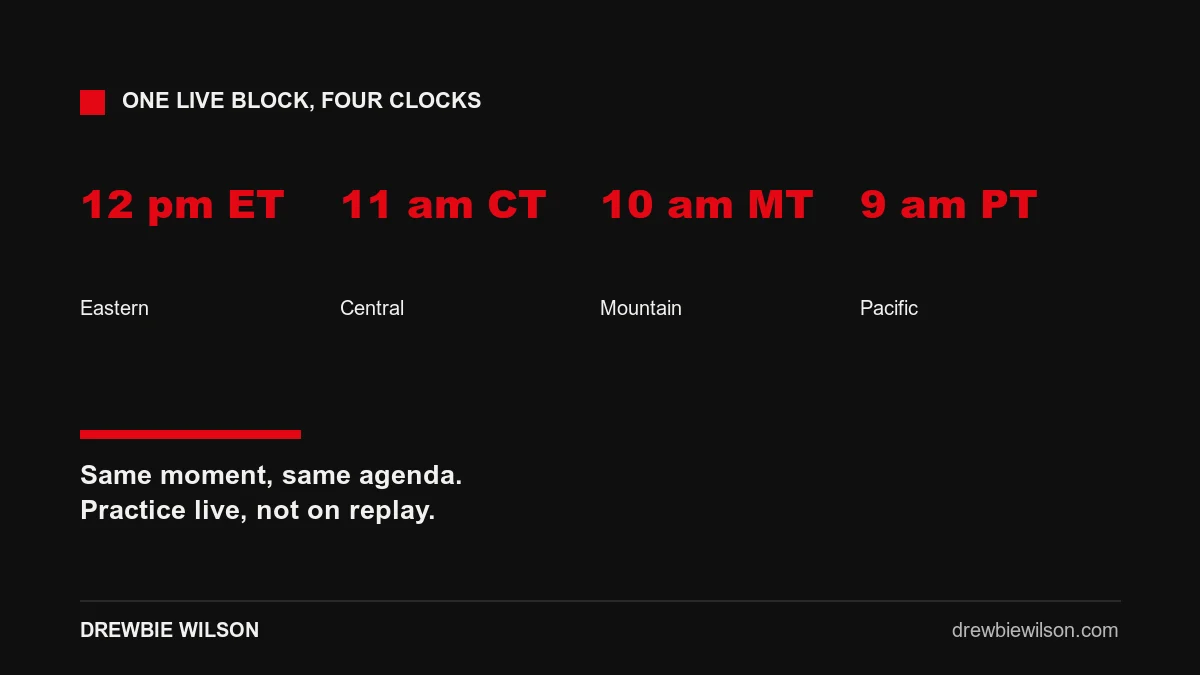
For a team across the four main US zones, if every zone works 8 to 5 local, the shared working hours run from 11 in the morning to 5 in the afternoon Eastern, which is 8 in the morning to 2 in the afternoon Pacific. Inside that stretch, avoid the first and last half hour. A block that starts at 12 pm Eastern lands at 11 am Central, 10 am Mountain and 9 am Pacific, so the earliest anyone joins is 9 in the morning and nobody has to stay late. Noon Eastern is the trade: the East Coast eats late that day, and the West Coast is settled in by 9.
Then check the calendar for conflicts that repeat: the Monday pipeline review, the Friday forecast call, the end-of-month rush. Pick a day that is clear in all zones.
If part of the team is in the US and part is in Europe or Asia, there may be no hour where everyone is awake and working. Do not stretch the block to 10 pm for one group. Split the team into two cohorts and run the same live session twice.
Three rules keep a split from turning into two different trainings:
It costs a second session, and that is the real price of a split team. The alternative is a single session where half the room joins at midnight and gets nothing from it.
Here is one way to lay it out for a team in four US zones, with a single live block, a practice assignment and a manager check-in in each zone.
| Zone | Live block, local time | Practice assignment, within 24 hours | Manager check-in |
|---|---|---|---|
| Eastern | 12:00 pm | Three calls using the new opener, logged | Thursday, 15 minutes with each rep |
| Central | 11:00 am | Three calls using the new opener, logged | Thursday, 15 minutes with each rep |
| Mountain | 10:00 am | Three calls using the new opener, logged | Thursday, 15 minutes with each rep |
| Pacific | 9:00 am | Three calls using the new opener, logged | Thursday, 15 minutes with each rep |
Keep the live block to 90 minutes. A simple shape works well: 10 minutes to review last week's assignment, 40 minutes of practice in pairs or small groups with the trainer moving between them, 25 minutes of feedback in front of everyone, and 15 minutes where each rep says out loud the one thing they will do before the next session.
Also decide up front what happens when a rep cannot attend. A 30 minute make-up slot at a different hour, held live with the trainer or a trained manager, keeps the practice intact. A link to the replay does not.
The table is deliberately boring. Every zone does the same thing at the same moment, just on a different wall clock. That is what makes a distributed team feel like one team. The hour is shared, the work is shared, and the check-in has the same shape wherever the rep sits.
A live session built on this schedule is what virtual sales training from Drewbie is designed for: live interactive sessions, with breakouts, role-play and real scripts, rather than a webinar.
The session is 90 minutes. The habit is built in the days around it, and that is the manager's job. The risk with a distributed team is that the managers in each zone develop their own version of the follow-through, and the team ends up with four standards.
Give every manager the same short list. Check the same number, on the same day, in the same way. The 100/10/2 Standard is a good number for this, because it is daily and it is the same in every zone: 100 attempts, 10 real conversations, 2 sales closed. Adjust the target by role if you must, but keep the same shape in every zone. Call The Damn Leads covers why reps quit before it pays off in its 100/10/2 article.
If the managers themselves need a common playbook for pipeline reviews and daily coaching, that sits with sales leadership training. And if the team being trained is made up of SDRs and AEs, what to coach each week for SDRs and AEs gives the weekly topics. To judge whether the schedule worked, record each zone's numbers the week before and compare them 30 days after, using the method in how to measure sales training ROI.
The honest take. Sometimes the schedule is blamed for something else. If a rep skips the live block even when it falls at 10 in the morning in their own city, the clock is not the cause. That is an accountability conversation, and no calendar change will fix it.
Rotating the pain is another option when a team truly cannot find a shared hour. If one cohort has to join early this month, flip it next month so the same people are not always the ones giving up their mornings. People accept an inconvenient hour more easily when they can see it is shared fairly.
A quick test: look at attendance by zone. If one zone attends at half the rate of the others, the time is wrong for that zone and you should move it. If attendance is low everywhere, or low for the same few names, the problem is not geography. Fix the schedule when the data says it is the schedule, and have the harder conversation when it says it is not.
Virtual sales training runs as live interactive sessions with breakouts, role-play and real scripts, built around your stack, your sales motion and your time zones.
Get virtual sales training