
Most advice on how to fix a broken sales process is written for a company that has never had one. Define your stages, align marketing and sales, train the team, buy a CRM. Fine if you are starting from zero. But if you are reading this, you have a process. Leads come in, reps work them, some close. The problem is that the number that comes out the bottom is smaller than it should be, and nobody can say where the rest went.
That is a leak, and a leak lives in one stage. You do not fix a leak by rebuilding the house. You find the stage, fix that stage, and pull the number again in 30 days. Here is how I do it, in the order the stages usually fail.
When revenue is flat and the pipeline looks full, the instinct is to change everything at once: new script, new CRM, new hire, new comp plan. Four changes in a month means you cannot tell which one mattered, and the team stops trusting any of them.
Start smaller. Every sales process is a chain of stages, and leads leave the chain at one of them more than the others. Find that stage first. If you have not counted anything yet, run a sales process audit and come back with the stage where the biggest drop sits. If you already know where deals stall, skip the audit and go straight to the fix for that stage below.
One rule for the whole exercise: fix one stage, measure one number, then decide about the next stage. Two fixes at once is a guess with extra steps.
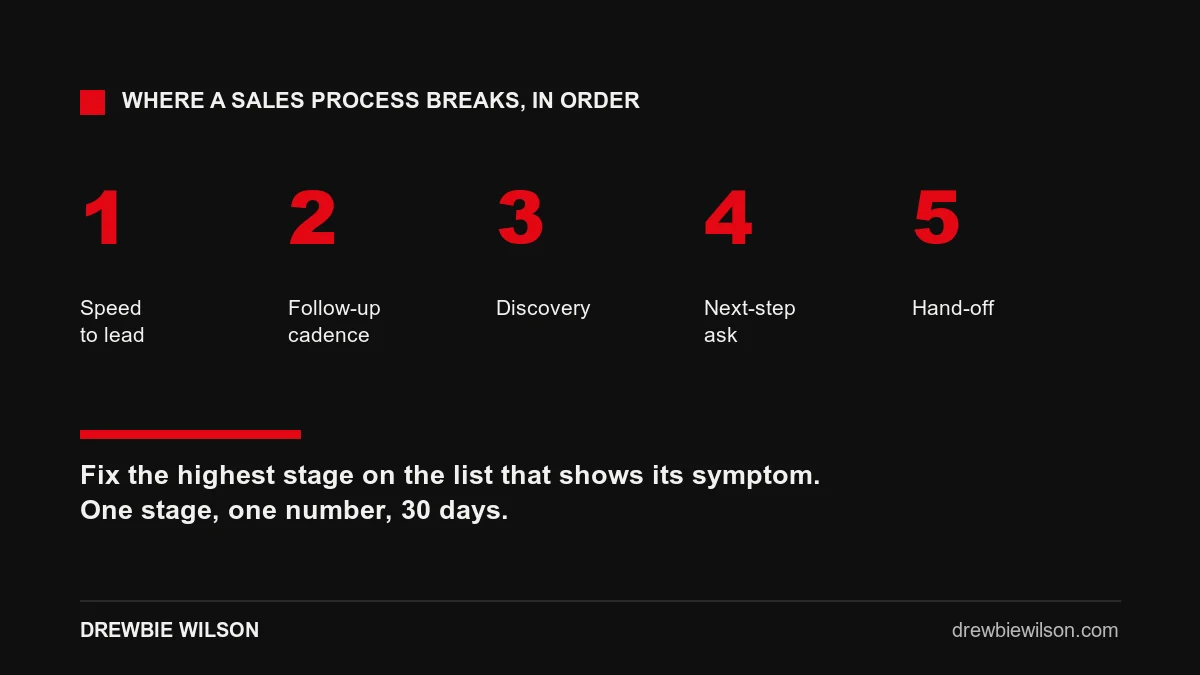
These are the stages I see fail most, ranked by how often I find the leak there. Each one has a symptom you can spot in an afternoon.
If you only fix one stage this quarter, make it the highest one on this list that shows its symptom. The stages above it are moving more leads than the stages below it.
In my experience, when an owner tells me the process is broken, the leak is follow-up far more often than anything else. Reps are quitting on leads before the lead had a chance to say yes. The fix has two parts, both written down, neither requiring a new tool.
First, a written cadence. Day 1, day 3, day 7, day 14, which channel on each day, and roughly what gets said. Every lead gets the same sequence whether the rep likes the lead or not. If you want the full build, building a lead follow up system walks through it step by step, scripts included.
Second, a daily activity floor. The cadence only runs if there is time protected to run it. The floor I use is the 100/10/2 Standard: 100 outbound attempts, 10 meaningful conversations, 2 sales closed. The exact number changes by role, but a rep with no floor will always find something to do that is not touch five on a lead that has not answered yet.
The number to re-check at 30 days: touches per lead before it is marked lost. If it was two and it is now six, the stage is fixed, and you will see it in closes a cycle later.
If follow-up is healthy and deals still die between the first real conversation and the proposal, the leak is inside the call. Usually the discovery is thin or the next-step ask is missing, and both come from the same cause: every rep runs the conversation differently, so nobody can tell which part is failing.
Give the team one structure. The one I use is the C.A.L.L.S. framework: Confirm the reason you are speaking, Ask, Listen and take CRM notes, Lay out a plan, Secure the bag. When every call follows the same five steps, the missing step shows up in the notes within a week, and it is nearly always the last two. The reps ask good questions and then never lay out the plan or secure the next meeting.
The fix is not a closing seminar. It is a rule: no call ends without a dated next step in the CRM, and the manager reads the last five calls' notes every Friday. Closing without being pushy has the exact lines for the ask, if the team is skipping it because it feels aggressive.
The number to re-check at 30 days: the share of first conversations that end with a booked next meeting.
The whole method in one table. Find your symptom in the first column and work across.
| Symptom you see | Stage that is broken | The one fix | Number to re-check in 30 days |
|---|---|---|---|
| Hot leads are cold by the time a rep calls | Speed to lead | A named owner and a five-minute first-touch rule for every new lead | Minutes from new lead to first touch |
| Leads marked lost after one or two touches | Follow-up cadence | Written day 1 / 3 / 7 / 14 cadence plus a daily activity floor | Touches per lead before it is marked lost |
| Proposals with no named problem or cost | Discovery | Run every call on C.A.L.L.S.; the Ask and Listen steps get logged in the buyer's words | Deals with a named problem and cost in the CRM |
| Calls end with "I'll send something over" | Next-step ask | No call ends without a dated next step; manager reads five sets of notes weekly | First conversations that end with a booked meeting |
| Warm leads stop answering after reaching the closer | Hand-off | A one-screen hand-off note: who, what they said, what was promised, when | Leads that get a closer touch within one day of hand-off |
The honest take. The three most common responses to a leaking process all make it worse. More reps pour more leads into the same hole and the leak gets bigger in absolute terms. Another tool moves the leak into a new dashboard where it is easier to ignore. And a motivation day, which I get paid to deliver, lifts the room for a week and changes nothing about touch five, unless the room walks out with a number to hit. If you are choosing between a speaker and a cadence, here is when the speaker is worth it and when it is not. Fix the stage first. Then the tool, the rep and the keynote all have a working process to land on.
Sometimes the audit comes back and three stages are leaking at once. Speed to lead is slow, follow-up stops at touch two, and calls end with nothing booked. That is not a patch job. Fixing one stage will move one number, and the other two will keep draining the pipeline while you wait 30 days to see it.
That is the point where the process needs to be rebuilt as a system: how leads come in, how they are worked, and how they get closed, with the stages, the cadence and the accountability designed together. It is also the point where doing it yourself starts costing more than it saves. When to hire a sales consultant lists the signs, and there is a reason the research favors doing it properly: HBR reported that companies with a formal sales process generate up to 18% more revenue growth than those without one.
If the leak is the follow-up stage alone and you want it built rather than described, follow-up system training installs the cadence, scripts and accountability with your team. If it is the whole engine, that is what Drewbie's sales consulting does with owners: rebuild the process, the follow-up, the CRM and the lead stages so deals stop dying in the gaps. Either way, the method is the same one in this post. Knowing how to fix a broken sales process starts with refusing to fix all of it at once.
Send me your stage counts for the last 90 days. I will tell you which one to fix first, what the fix is, and what the number should read at day 30.
Talk to Drewbie about sales consultingSources: Harvard Business Review, The Short Life of Online Sales Leads · Harvard Business Review, Companies With a Formal Sales Process Generate More Revenue · Call The Damn Leads, the C.A.L.L.S. framework · Call The Damn Leads, the 100/10/2 outbound sales standard