
To close without being pushy, stop treating the close as a separate move you make on someone. Make it the natural last step of a conversation you already earned. Here is the line I teach every rep: the close isn't a move you make on them, it's the door the conversation already walked you to. When the ask feels aggressive, it is almost never because you asked. It is because you skipped the steps that make the ask feel obvious.
That is the whole secret to how to close a sale without being pushy. Pushiness is not a personality flaw and it is not something you fix with a smoother tone of voice. It is a symptom of a broken sequence. So this post gives you the sequence, the C.A.L.L.S. framework, plus the exact words to say at the moment most reps freeze. Steal all of it.
Reps who feel pushy usually think the answer is to soften up: smile more, apply less pressure, be more "consultative." That treats the symptom. There are three real, mechanical causes, and every one of them is fixable this week.
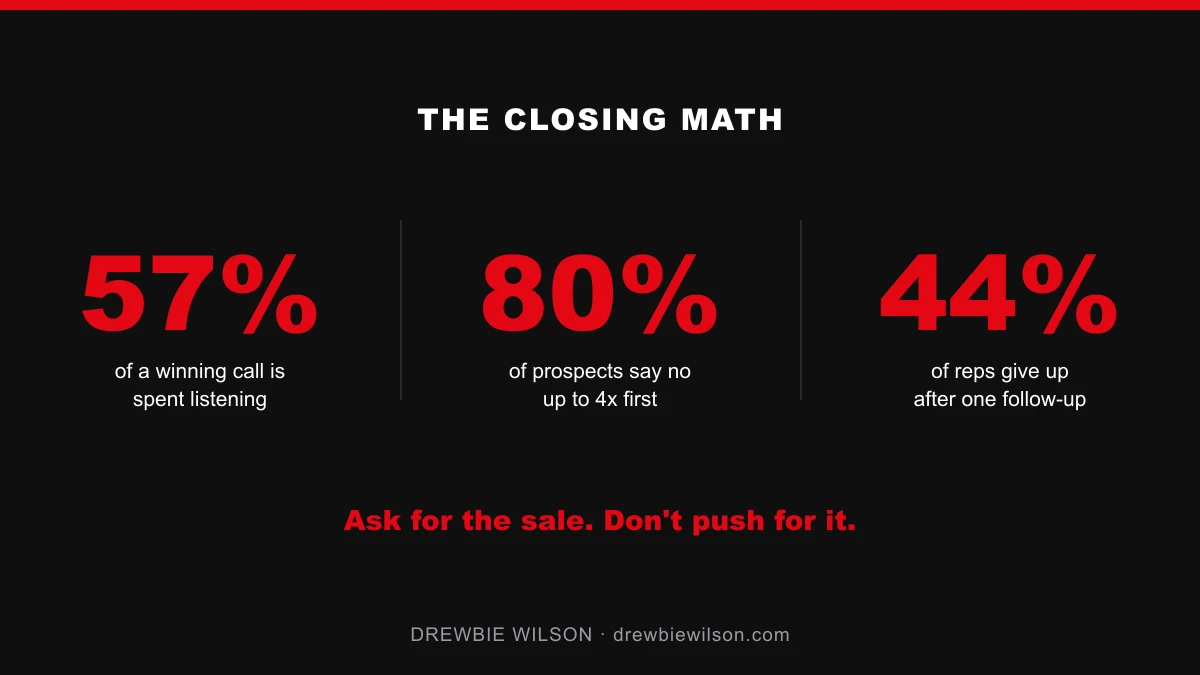
1. You pitched before you listened. When you lead with features and talk more than the buyer, the close has to do all the work, because you never uncovered a reason for them to say yes. The best closers spend most of a winning call listening, not pitching. Talk first and you back yourself into a corner where the only exit is pressure.
2. You asked before you earned permission. A close that lands cold, with no agreed-upon problem and no agreed-upon plan, feels like a stranger grabbing your arm. The buyer has not signed off on any of the small steps that make a yes feel safe, so the big yes feels like a trap.
3. Your pipeline is thin, so this one deal has to save you. This is the cause nobody on page one connects to tone, and it is the biggest one. When a single close carries your month, the buyer can smell the desperation through the phone. Pressure is math: fewer conversations means every one matters too much. Enough conversations means no single close carries desperation, which is the actual mechanical cause of pushiness.
Here is the 30-second self-diagnostic. This is the 100/10/2 standard: 100 touches, 10 real conversations, 2 new opportunities, every working day. Ask yourself honestly: am I hitting a daily activity number, or is my whole month riding on the two or three deals in front of me right now? If it is the latter, you do not have a closing problem. You have a pipeline problem wearing a closing costume. Fill the top of the funnel and half of your "pushiness" evaporates on its own, because no single yes has to save you.
Every close I run follows the same five steps in the same order. Run them in sequence and the ask at the end feels like a formality, because the buyer already agreed to everything that leads to it. This is the "Secure the Bag" step of the C.A.L.L.S. framework, broken all the way down.
Before you pitch anything, say the problem back to them out loud, using their language. This proves you listened and it gets a yes on the tape before any ask.
Say: "So if I heard you right, the real issue is [their exact words], and if that keeps going, it costs you [their stakes]. Did I get that right?"
You are not allowed to move forward until they say yes here. That yes is the foundation the close sits on.
You do not launch into a pitch. You ask for the door to be opened. Permission removes the pressure because they invited the next part.
Say: "I have got a couple of ways I think we can fix that. Want me to walk you through what that would look like for you?"
Almost nobody says no to this. And once they say yes, they are leaning in, not bracing for a pitch.
While you lay out the fit, you keep checking in instead of monologuing. Every 60 seconds you hand the conversation back. This is where the top closers separate: they listen the majority of the call.
Say: "Before I keep going, how does that line up with what you were picturing?"
If they push back, good. You just found the real objection while there is still time to solve it, instead of getting ambushed at the close.
Do not sell the product. Sell the specific next 30, 60, 90 days for THEM. A plan is concrete and calm. A pitch is abstract and anxious.
Say: "Here is exactly what the first 30 days look like for you: [step one], then [step two], and by [milestone] you should see [their stated outcome]."
When the plan is clear and tied to the outcome they confirmed in step one, the close is no longer a leap. It is the obvious next line.
Now, and only now, you ask. And because you ran the four steps above, the ask is small, specific, and expected. You are not asking them to gamble. You are asking them to start the plan they already agreed with.
Say: "The plan makes sense to you, so the only thing left is to get you started. I can get you set up today. Want me to?"
That is the whole system. The close felt pushy in the past because you tried to do all five jobs in the last sentence. Spread them across the conversation and the last sentence does almost no work.
Here are seven closes you can say word for word. None of them apply pressure, because each one just names a decision the conversation already led to. Pick by situation.
Notice what none of these do: none of them beg, none of them discount to force a yes, and none of them pretend a decision is smaller than it is. They just open the door.
"Let me think about it" is almost never about thinking. It is a polite exit that hides the real objection. Pushing here is what makes reps look desperate. Instead, isolate the real issue with a calm question. Here are three word-for-word responses.
Response 1 (permission to be honest): "Totally fair, and I would rather you think it over than feel rushed. Just so I know I explained it well: when you say think about it, is it the price, the timing, or something about whether this will actually work for you?" Naming the three usual suspects gives them an easy, honest lane to tell you the truth.
Response 2 (the future-pace): "Makes sense. When you picture thinking it over, what is the actual question you will be turning over in your head? If I can answer it now, great. If not, no pressure." This gets the specific objection out of their head and onto the table where you can address it.
Response 3 (the calm close-behind): "No problem at all. A lot of people say that when there is one piece that is not fully clear yet. If everything lined up and it clearly got you to [their outcome], is there any reason you would not move forward today?" If they say no reason, the "thinking" was fake and you can gently re-close. If they name a reason, you just found the real objection.
The move in all three is the same: you never argue with "let me think about it." You turn it into a real question you can actually answer.
Most deals die in the follow-up, and most reps quit after one try, right before the close would have landed. But there is a difference between following up and nagging. Nagging asks for something every time ("just checking in," "any update?"). A non-pushy follow-up gives something every time. Here is a value-first 3-touch cadence with exact timing.
If you want the full version of this, with the exact channels and timing for every stage, I broke it down in a lead follow up system and in why leads go cold.
Before you ask for any sale, run this list. If you cannot check all six, do not close yet. Go back and get the missing piece. This is the whole difference between confident and pushy.
That last box is the one everybody skips, and it is the one that controls your tone more than any script. Keep the top of your funnel full and the close takes care of itself.
The pipeline math behind a pressure-free close comes from the 100/10/2 standard on Call The Damn Leads.
A calm close depends on the questions you asked twenty minutes earlier, so if the Ask step feels thin, here is how to ask better sales questions and use what you hear.
Drewbie coaches reps and teams to run the full C.A.L.L.S. close: the sequence, the scripts, and the pipeline discipline that makes closing feel calm instead of desperate.
Work With DrewbieClosing a sale without being pushy is not a talent you are born with. It is a sequence you run. Confirm the problem, ask permission, listen, lay out the plan, secure the bag, and keep your pipeline full enough that no single yes carries desperation. Do that and the close stops feeling like a shove. It starts feeling like the door the conversation already walked you to. If you want the deeper mechanics, they live inside 1:1 sales coaching to install your closing system.
Sources: Gong Labs talk-to-listen ratio research (gong.io). Marketing Donut sales persistence statistics (marketingdonut.co.uk). Invesp follow-up sales statistics (invespcro.com).