
Role-play is the first thing to go wrong when a sales team moves onto video. In a room, everyone can see who is working and who is hiding. On a call, the room is a grid of tiles, half of them dark, and the rep who needs the practice most is the one with the lights off. Virtual sales role play facilitation is the manager's job of making the live exercise safe, short and watched, so reps stay on camera and actually say the words.
This post covers one session format a manager can run in 45 minutes. It is about running a live exercise with real people on the other side of the screen, not about practice software.
Three things change the moment the group is remote. The first is that nobody can see body language, so the awkward pause that tells a manager a rep is stuck is invisible. The second is that switching between a full group and small groups takes a deliberate step, so the exercise drifts into one big conversation where two people talk and everyone else coasts. The third is that a camera feels like exposure. A rep rehearsing a cold open in front of ten colleagues has more to lose than the same rep alone with a buyer who is a teammate.
None of these is a technology problem. They are facilitation problems, and each has a fix the manager controls: a rule, a format and a job for every person on the call.
Say it once, at the top, in one sentence: "For the next 45 minutes cameras are on during rounds, and if yours cannot be, tell me now and you take the observer seat." That sentence does three things. It makes video the default instead of a favor. It gives the rep with a real reason, such as a bad connection or a shared space, a way out that does not single them out. And it puts a job on the person who is off camera, so the choice does not come with a free pass.
Do not argue with a camera-off rep in front of the group. If someone is dark for every session over several weeks, that is a one-on-one conversation afterward, not a debate in the middle of round two.
Keep the stakes low in the framing too. Tell the group the exercise is for the person doing it, not for the manager's scorecard, and that nothing from the round goes into a review. Reps turn cameras on for a practice that feels like practice.
Use trios. In every trio, one rep is the seller, one plays the buyer from a one-paragraph brief you hand out, and one watches. After ten minutes the roles rotate, so each rep has done all three jobs by the end. The observer role is what makes this work on video, because the observer is the one person in the room who is not performing and can see everything.
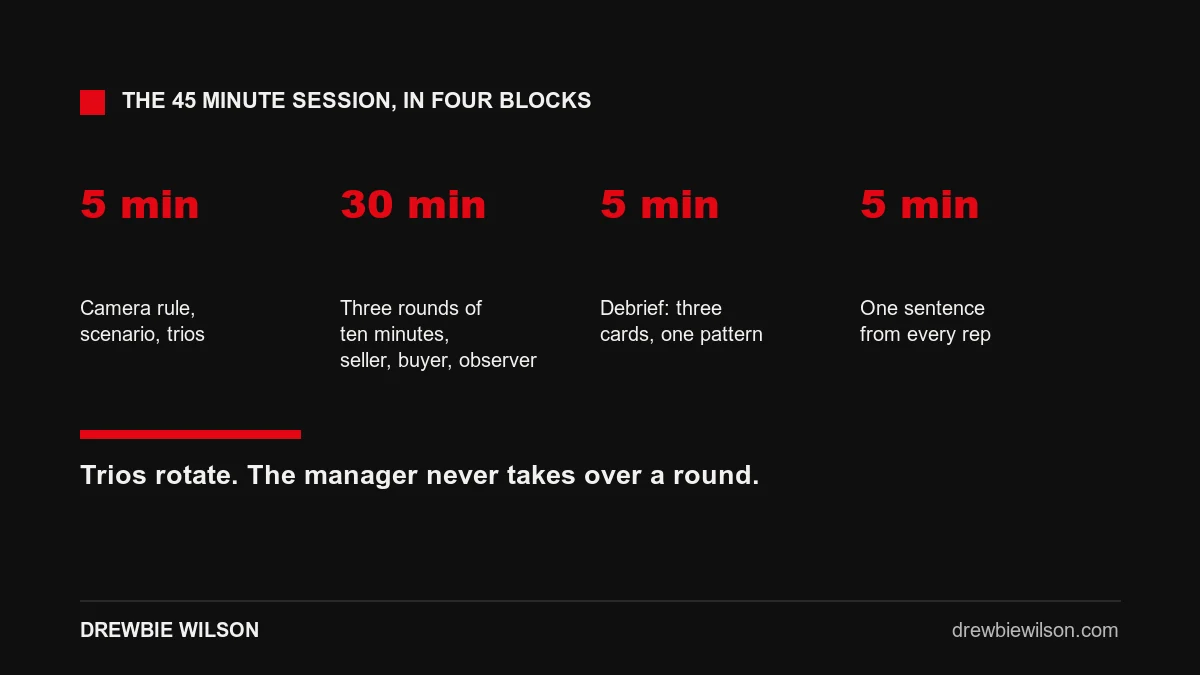
| Minute | Who talks | Who watches | What the manager does |
|---|---|---|---|
| 0 to 5 | Manager | Everyone | States the camera rule, reads the scenario aloud, sends trios to breakout rooms |
| 5 to 15 | Seller and buyer, 6 minutes, then the observer, 4 minutes | Observer | Drops in on each trio for about two minutes, says nothing unless a round is stuck |
| 15 to 25 | New seller and buyer, same split | New observer | Visits the trios it skipped in round one |
| 25 to 35 | Last pairing, same split | Last observer | Notes one pattern it hears across rooms |
| 35 to 40 | Manager runs the debrief, whole group | Everyone | Reads three observer cards, names the pattern |
| 40 to 45 | Each rep, one sentence | Everyone | Writes down every commitment |
Give the buyer a real brief, not a script. Two or three lines are enough: who the buyer is, what they care about this quarter, and one objection they will raise. A buyer with a script plays the scene like a recording. A buyer with a situation reacts to what the seller says, which is what a real buyer does.
Pick one skill per session. Practicing an opener, an objection and a close in one hour means practicing none of them. Choose the step of the C.A.L.L.S. framework where your team's last ten calls went wrong and build all three rounds around it.
The observer is not a judge. The observer is a note-taker with a three-line card, and the card is the same every round:
The first line matters most. A rep who hears their own good sentence read back to them knows what to keep. A rep who only hears what to fix leaves the exercise with a list of mistakes and a lower opinion of practice. The third line trains the observer too, because finding the missing question is the same skill as asking it on a live call.
Ask observers to write the card while the round is happening and to read it aloud only when the ten minutes are up. That keeps feedback from interrupting the seller mid-sentence, which is the quickest way to end a rep's willingness to try anything new.
Rounds stall. The seller freezes, the buyer plays too hard, or the pair finishes in three minutes with nothing to say. The manager's job is to restart the round without becoming the seller. Three moves cover most of it:
What not to do: do not unmute and demonstrate. The moment the manager performs the call, the trio becomes an audience and the rep learns that being stuck means being replaced.
Debriefs on video run long and thin. Keep the order fixed so it stays at five minutes. First, the manager reads three observer cards aloud, one from each rotation, choosing "repeat" lines first. Second, the manager names the one pattern heard across rooms, such as reps skipping the confirm step or asking two questions at once. Third, the manager asks each rep for a single sentence: the one thing they will do differently on their next live call.
Write every sentence down and use it. The next team meeting should open with "last week you said you would...", and the manager should check it in the next one-on-one. A practice session with no follow-through is a nice hour. A session whose commitments get checked changes how calls sound. The same discipline sits underneath the 100/10/2 Standard: a daily number the rep controls and the manager inspects.
Feedback with a teacher is what separates practice that builds skill from repetition. Harvard Business Review's The Making of an Expert makes the case that expert performance comes from deliberate practice, which includes guidance from someone who gives tough feedback. The observer card and the manager's debrief are how a sales team gets that feedback on a call.
If you are running this with a team spread across regions, running sales training across time zones covers how to pick the hour. And when you want an outside trainer to run the sessions live, virtual sales training from Drewbie is built for it, with breakouts, role-play and real scripts. For the whole team on one program, see sales team training.
The honest take. A camera rule fixes a habit. It does not fix a rep who has decided the exercise is pointless. If a rep keeps the camera off, the mic muted and the observer card blank for three sessions running, the format is not the issue. That is a coaching conversation about why practice feels like a threat, and it belongs in a one-on-one.
Check the pattern before blaming the person. If cameras go off whenever the scenario is a cold call and stay on for a renewal conversation, the exercise is too hard, not the rep too shy. Start the team on the version they can do and raise the difficulty a notch each session.
Real sessions, not webinars: live virtual sales training with breakouts, role-play and real scripts, in sessions built around your stack and your sales motion.
Get virtual sales training