
Most teams plan the workshop and leave the weeks after it blank. The day itself goes well. Reps take notes, someone says it was the best session in years, and by the third week the old habits are back because nobody was assigned to hold the new ones. The fix is not a longer workshop. It is a calendar for the 90 days that follow, with a name next to every week.
Below is the version I would put on a manager's calendar before the trainer ever walks in.
A workshop changes what reps know. It does not change what they do on a Tuesday afternoon with a full pipeline and a hard call to make. Between the two sits a handful of small decisions: whether to make the next call, whether to log it, whether to try the new opener or fall back on the old one. Each decision is easy to skip, and nobody notices when it is skipped unless someone is looking.
Three things usually happen. The manager assumes the trainer's follow-up resources will do the work. The reps assume the manager will ask if it matters. And the manager, buried in the quarter, never asks. Nobody refused anything. The cadence simply had no owner.
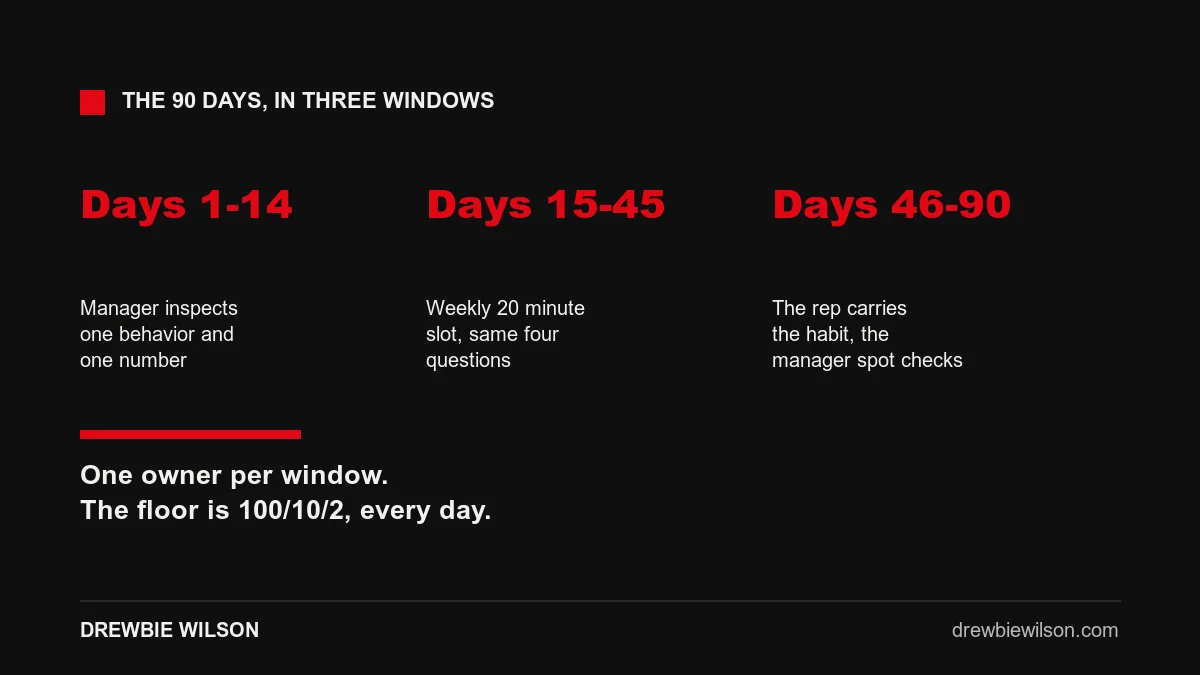
So before the session, put three entries on the calendar: a day 14 check, a weekly 20 minute slot from day 15, and a day 90 review. If you are still choosing who runs the session, the questions in what to ask a sales trainer before you sign belong before this plan, not after it.
In the first two weeks, the manager does one job: look at one behavior and one number for every rep, every day. Not five behaviors. One.
Pick the behavior the workshop was built to change. If it was follow-up, the behavior is a second and third touch on every open lead. If it was opening calls, it is the new opener on the first ten dials of the day. Then pair it with a number the CRM already holds, and write both on a sheet the whole team can see.
Two rules keep this from turning into surveillance. First, the manager says out loud on day one what will be checked and when. Second, the first conversation about a short number starts with a question, such as "what got in the way yesterday?" The reps are still learning. The point of the first two weeks is to prove that somebody notices.
If you baselined your numbers before the session, as how to measure sales training ROI lays out, this is where that baseline earns its keep. The manager is comparing each rep to their own starting line, not to the loudest person on the team.
From day 15 the manager moves from daily glances to a fixed weekly slot of 20 minutes per rep or per pod. Same day, same time, same four questions. The slot matters more than the questions, because a meeting that moves is a meeting that dies in week five.
| Window | Owner | What gets inspected | If it slips |
|---|---|---|---|
| Days 1 to 14 | Manager, daily | One behavior, one number, on a shared sheet | Ask what got in the way, fix it that day |
| Days 15 to 28 | Manager, weekly slot | The same number, plus one call replay or one lead history per rep | Shorten the target for one week instead of dropping it |
| Days 29 to 45 | Manager, weekly slot | The number, plus the day 30 comparison against the baseline | Name the one rep or habit pulling it down and coach only that |
| Days 46 to 60 | Manager and rep together | Rep brings their own number and one thing to change | Return to a daily glance for that rep for one week |
| Days 61 to 90 | Rep, with a manager check every other week | The number only, and a spot check of the log | Run the day 90 review early |
The four questions for the weekly slot are short. What did you do differently this week? What number moved? What got in the way? What is the one thing you will repeat next week? Write the answer to the last question on the sheet. It becomes the opening line of the next meeting, which is what turns twenty minutes into a rhythm.
Around day 30, re-pull the same numbers you baselined. A rep whose conversations per 100 attempts moved is applying the training. A rep whose numbers are flat has an obstacle you can name. The audit in the sales manager CRM activity audit is the fifteen minute weekly pass that checks the follow-up happened, and it fits inside this slot as one line item.
By the second half of the program, a manager who is still inspecting everything has built a dependency, not a habit. The aim is for the rep to run the check on themselves.
Starting around day 46, ask each rep to bring their own number to the slot and say what they will change. The manager stops reading the log line by line and starts spot checking it. If the numbers hold, the weekly slot can drop to every other week for that rep. If they slip, the slot goes back to weekly without any drama, and nobody calls it a demotion.
What the manager stops checking is as important as what they keep checking. Drop the daily glance for any rep whose number has held for three weeks in a row. Keep it for anyone new to the team, since their day 1 is not the same day 1. Handing off early to a steady rep also frees time for the rep who needs more of it, which is where a manager's attention does the most good.
A coaching rhythm this plain matches the guide to building a coaching culture on Call The Damn Leads: put what good looks like in writing, so nobody has to guess, and hold regular coaching sessions so everyone stays on the same page.
The number in all of this should be one the rep controls. That is the reason the 100/10/2 Standard works as the thing to inspect. It is a daily standard: 100 outbound attempts, 10 real conversations, 2 sales closed. Write the target for each role down before day one and use it as the minimum the weekly slot checks against, not as a ceiling.
It is worth saying plainly that the standard is daily. If your weekly slot compares a rep to it, multiply by five working days before judging anyone. The arithmetic is simple, which is the point. The origin of the standard and why reps quit before it pays off are in the Call The Damn Leads 100/10/2 article.
The honest take. A 90 day plan does not guarantee the training worked. Some programs should be stopped. If the numbers never moved and the weekly slot ran on schedule, the problem is the content or the fit, and another quarter of the same thing will not repair it.
On day 90, the manager writes three lines and shows them to whoever approved the spend:
Those three lines decide the next move without a debate. When the habit stuck and the number moved, extend it to the next pod. When the habit stuck and the number did not move, the training was aimed at the wrong behavior. When neither moved, look at the cadence first and the content second, since an unowned week can sink a good session.
If your managers have never been taught to run a cadence like this, that is a skill with its own training. Sales leadership training covers the pipeline review, the daily coaching conversation and the activity standard the manager inspects. For the sessions themselves, sales team training comes with follow-up resources so the new habits stick.
Sales team training runs hands-on, with live practice, real scripts and follow-up resources, shaped around how your team sells.
Get sales team trainingSources: Call The Damn Leads, building a coaching culture · Call The Damn Leads, the 100/10/2 standard