
A buying committee champion unresponsive for ten days is one of the most common ways a good deal starts to slip. The demo went well, the champion was warm, and then the replies stopped. Most reps respond in one of two ways. They send the same follow-up again, or they wait and hope. Neither one tells you anything new.
Here is a two-week plan that does tell you something, and a rule for when to stop.
There are three common reasons, and each one needs a different move.
You cannot tell which of the three it is from the outside, and guessing is how reps end up writing long, hopeful emails. The goal of the first message is to make it easy for your champion to tell you, in one line, which one it is. Buying groups keep getting bigger, and Harvard Business Review describes a growing number of people involved in each purchase. That is the reason one contact should never carry a deal.
Do not resend your last email with "bumping this up" on top. Write something new and short. It should fit on a phone screen, ask for one thing, and let your champion answer with a single word.
Here is the shape that works:
That last line matters more than it looks. People stop answering when every reply feels like a commitment. Give them permission to say it is not a priority right now and a surprising number of them will. A "no" for now is real information. A hopeful guess is not.
If you want the message on a different channel, text or a short call attempt are both fine. The sending itself is covered well in Call The Damn Leads on the follow-up email after no response. This post does not write that email. It decides what comes after it.
If day four arrives with no answer, widen the thread. In discovery you should have met or at least heard the name of a second person on the committee: the technical evaluator, a user, someone in finance. This is the moment to use that name.
The way you frame it decides how it lands. "I could not reach my champion, so I am emailing you" sounds like an escalation, and it can get your champion in trouble. Try a version that is about being useful to them:
Both are real things you can send that do not mention the missing reply. If the second person answers, you learn the state of the deal without ever calling your champion out. If you are not sure who else to contact, the question list in discovery questions by buying committee role shows what to learn from each seat, and the habit of asking better sales questions early is what gives you a second name to use now.
Put the plan in your CRM on day one, with dates, so it runs whether or not you feel like chasing that week.
| Day | Move | Who | What a reply means | What no reply means |
|---|---|---|---|---|
| 1 | One easy question with a way out | Champion | You know which of the three reasons it is | Go on to the next move, nothing is lost |
| 4 | Send something useful, with no reply asked for | Second contact | The deal is alive, and you have a second thread | The whole account may be stalled, not only your champion |
| 7 | One more short note, a different channel | Champion | Reopen with a smaller next step | Hold the next step for day ten |
| 10 | A short, direct ask for a decision on timing | Champion and second contact | You have a date or a "not now" you can plan around | Prepare the final note |
| 14 | Final note: leaving the door open, closing the file | Both | Treat it as a new conversation and restart the clock | Mark the deal and move your effort elsewhere |
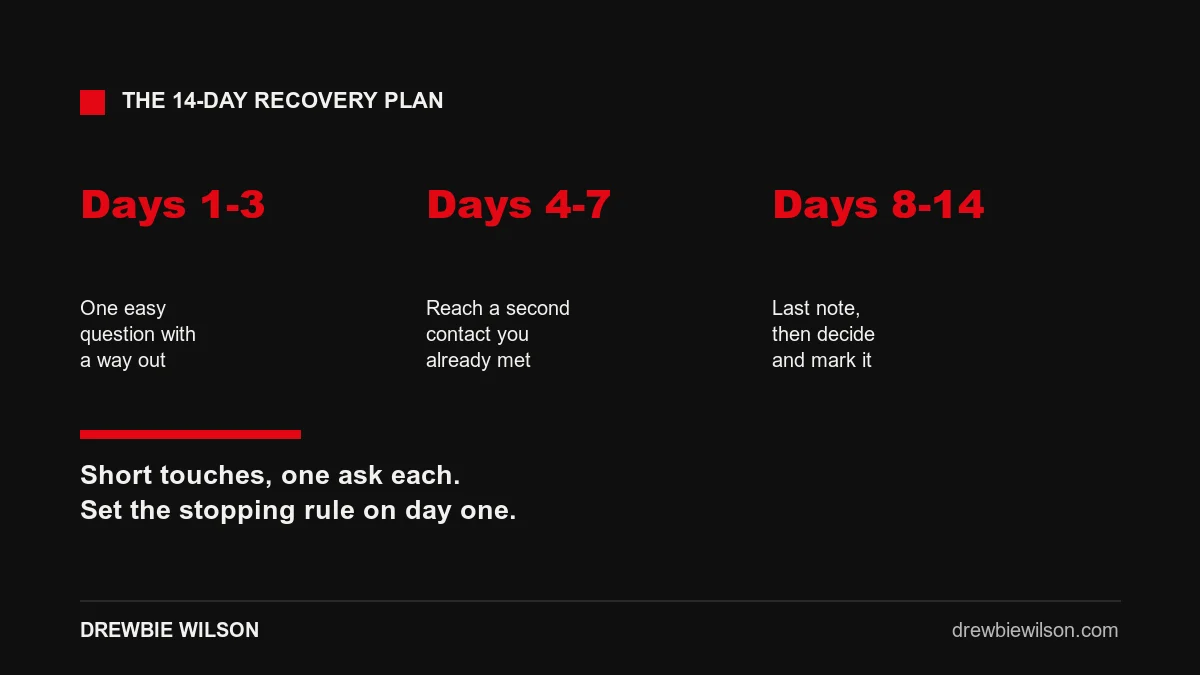
Notice what is missing. There is no long email, no pricing resend and no fresh deck. Every touch is short, every touch asks one thing, and no touch repeats the one before it. That is the difference between persistent and pushy, and it is the same idea behind the 100/10/2 Standard: keep the input steady and let the numbers tell you the truth.
The honest take. A deal you are chasing for a month with no reply from anyone is not a deal you are working. It is a deal you are worried about. Fourteen days of real, varied attempts across two people is a fair effort. After that, close the file in your CRM with the date and the last thing you heard, and leave the door open with one sentence.
The reason to stop is arithmetic. Every hour spent on a stalled deal is an hour not spent on new conversations. The standard is 100 attempts, 10 conversations and 2 sales closed every day, and a rep who spends the afternoon rewriting an email to a person who has not answered in three weeks is spending the day on the wrong number. The 100/10/2 standard article at Call The Damn Leads covers the same idea of persistence with a stopping point, on a longer clock for cold leads.
Marking a deal is not giving up on the account. Set a reminder for the next quarter. Champions come back, budgets reset, and a clean last note makes that conversation easier.
A buying committee champion unresponsive for a week will happen to you again. You can make sure one busy person does not stop the deal.
Teaching a team to build that second thread is the job of enterprise sales training from Drewbie, which takes reps through committee mapping and multithreading on their own live accounts. If deals stall on one contact quarter after quarter, the cause may sit in the process, and sales consulting starts with an audit of your sales process.
If the champion comes back and the next step is the person who signs, getting a second meeting with the budget owner covers that ask.
Enterprise sales training takes your reps through committee mapping and multithreading on their real accounts.
Get enterprise sales trainingSources: Harvard Business Review, The New Sales Imperative · Call The Damn Leads, the follow-up email after no response · Call The Damn Leads, the 100/10/2 standard