
Most sales teams do not have a closing problem. They have a leaking problem, and they have no idea where the leak is because nobody has ever counted anything. A sales process audit is how you find the hole before you spend another dollar on leads that fall through it.
I have run this teardown on my own pipelines for 20+ years on the way to $15M+ in personal sales, and the pattern barely changes: the leak is almost never where the team swears it is. Here is the exact five-step audit, the six numbers to pull, the stage scorecard, and the call-review rubric. Block half a day, run it top to bottom, and you will know more about your sales process than most consultants would tell you in a month.
The consensus definition holds up: a sales process audit is a systematic review of each stage of your selling motion, from first touch to closed deal, comparing what is supposed to happen against what the data says actually happens. The output is a short list of gaps ranked by revenue impact.
The refinement that makes it useful: audit activity before you audit skill. Most teams jump straight to "our demos need work" because critiquing technique feels productive. But if only 12 leads a week are reaching demo, your demo is not the problem. Count first. Judge second. That order is the entire discipline, and it is why the first two steps below are pure math.
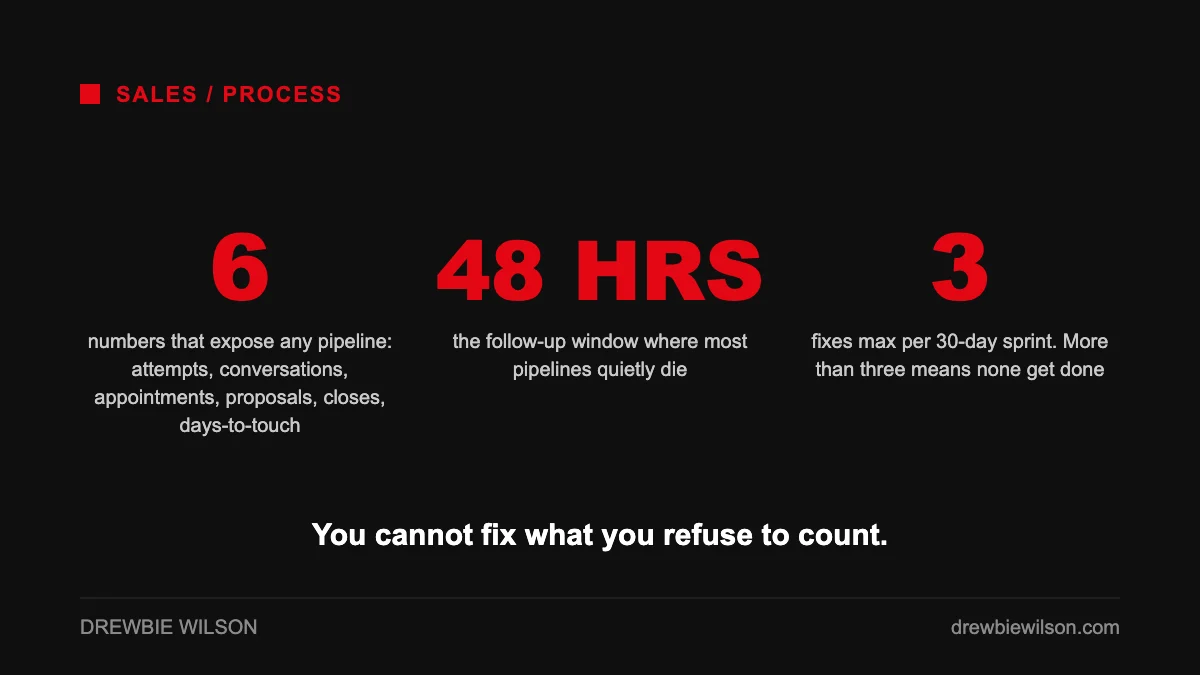
Open your CRM and pull 90 days of these six, per rep if you have a team:
Now compute three ratios: conversations per attempt, appointments per conversation, closes per proposal. Write them down. You have just built your funnel's fingerprint, and the weakest ratio is pointing at your leak.
Benchmark the top line against the 100/10/2 Standard: 100 attempts, 10 real conversations, 2 appointments per rep, every working day. Most teams that "need better closers" are running 20 attempts a day. That is not a closing problem. That is a starvation problem wearing a closing costume.
Walk your pipeline stage by stage and grade each one honestly. Green means the data proves it works. Red means fix it. There is no yellow, because yellow is where excuses live.
| Stage | The audit question | Green looks like | Red looks like |
|---|---|---|---|
| Lead capture | Does every lead land in one system with a source tag? | One CRM, zero leads in inboxes or sticky notes | Leads scattered across email, DMs, and memory |
| First touch | How fast does a new lead hear from a human? | Same business day, most within the hour | Days-to-first-touch over 2, or "when we get to it" |
| Qualification | Is there a written definition of a qualified lead? | Everyone recites the same 3 criteria | "We kind of know one when we see one" |
| Follow-up | Is there a fixed cadence with channel and day defined? | Documented 8+ touch sequence, logged every time | One voicemail, then hope |
| The ask | Do reps directly ask for the business, on record? | A close attempt audible on most late-stage calls | Proposals sent into silence |
| Handoff and tracking | Can you see every stage conversion in one report? | The six numbers pull in under 10 minutes | This audit took you two days of spreadsheet archaeology |
Count the reds. Two or fewer means you are tuning. Three or more means you are rebuilding, and the rebuild order is top of the table first: fixing follow-up before lead capture is bailing a boat that is still filling.
If you only audit one stage, audit this one. The response-time research is brutal: a Harvard Business Review audit of 2,241 companies found the average firm took over 42 hours to respond to a fresh web lead, while firms that responded within an hour were nearly seven times likelier to have a meaningful conversation with a decision maker. The Lead Response Management study behind it shows the odds of even reaching a lead collapse after the first hour. Your leak has a stopwatch on it.
Pull 20 leads from the last 60 days that did not close and answer, for each:
The pattern you will find is the same one I built a whole brand around: leads are not being lost, they are being abandoned. Two touches, then silence, while the lead buys from whoever called on touch number six. Read why leads go cold for the full breakdown of that failure mode. If your 20-lead sample shows an average of three touches or fewer, your audit finding is already written, and building the fix is exactly what follow-up system training exists for.
Numbers tell you WHERE the leak is. Recordings tell you WHY. Pull five real sales calls, ideally three losses and two wins, and score each against the C.A.L.L.S. Framework, one point per step:
Score each call out of 5, average the five calls, and log the score next to your stage scorecard. A team averaging under 3 has a call-quality gap you can now name step by step, which beats "we need to be better on the phone" by a mile.
An audit that ends in a 20-point improvement plan ends in a drawer. Cap the output at three fixes, ranked by revenue impact, each with an owner, a deadline, and the single number that proves it worked:
Then re-run the six numbers at day 30 and compare. The audit is not done when the report is written. It is done when a ratio moves.
Run this audit yourself first. You will fix the obvious leaks for free. Bring in help when one of three things is true: the numbers are too buried to pull, the reds outnumber the greens and nobody owns the rebuild, or the team keeps failing the same fix two sprints in a row. That third one is a people-and-accountability problem, and it is precisely the kind of teardown-and-rebuild work sales consulting with Drewbie handles: same audit, deeper cut, with someone in your corner who has run these numbers for 20+ years and is not emotionally attached to your excuses. Not sure you are at that point? Here is when to hire a sales consultant.
A sales process audit is not a document. It is six numbers, one honest scorecard, five graded calls, and three fixes with dates on them. Half a day of counting will tell you exactly where your revenue is leaking, and nine times out of ten the answer is sitting in your follow-up column, wide open, fixable by Monday.
The leads are already there. Call them.
Drewbie tears down sales processes for a living: the numbers, the calls, the follow-up, the fix list. You bring the CRM login. He brings the red pen.
Work With DrewbieSources: Lead response times and the one-hour window via Harvard Business Review, "The Short Life of Online Sales Leads" and the Lead Response Management study. The 100/10/2 Standard and C.A.L.L.S. Framework are Drewbie Wilson's own published methodology, not third-party claims.