
Getting a second meeting with the economic buyer is harder than getting the first one. The first meeting was a favor to your champion. The second is a decision by the person who owns the budget that you are worth more of their time. Many deals stall right here. The rep had a good call, heard "this looks interesting," and then spent three weeks waiting for a calendar invite that never came.
This post covers what to do before, during and after meeting one so that meeting two gets booked.
A budget owner who joins a call is usually protecting their time. They listen, they ask two or three pointed questions, and they leave with a general impression. Unless you gave them a reason to continue, the polite default is "send me something" and no next step.
There are three common causes.
All three can be fixed before the call ends. The questions to ask each person at the table are in discovery questions by buying committee role. Call The Damn Leads covers the first call itself in its guide to the discovery sales process. This post starts after that first conversation is done.
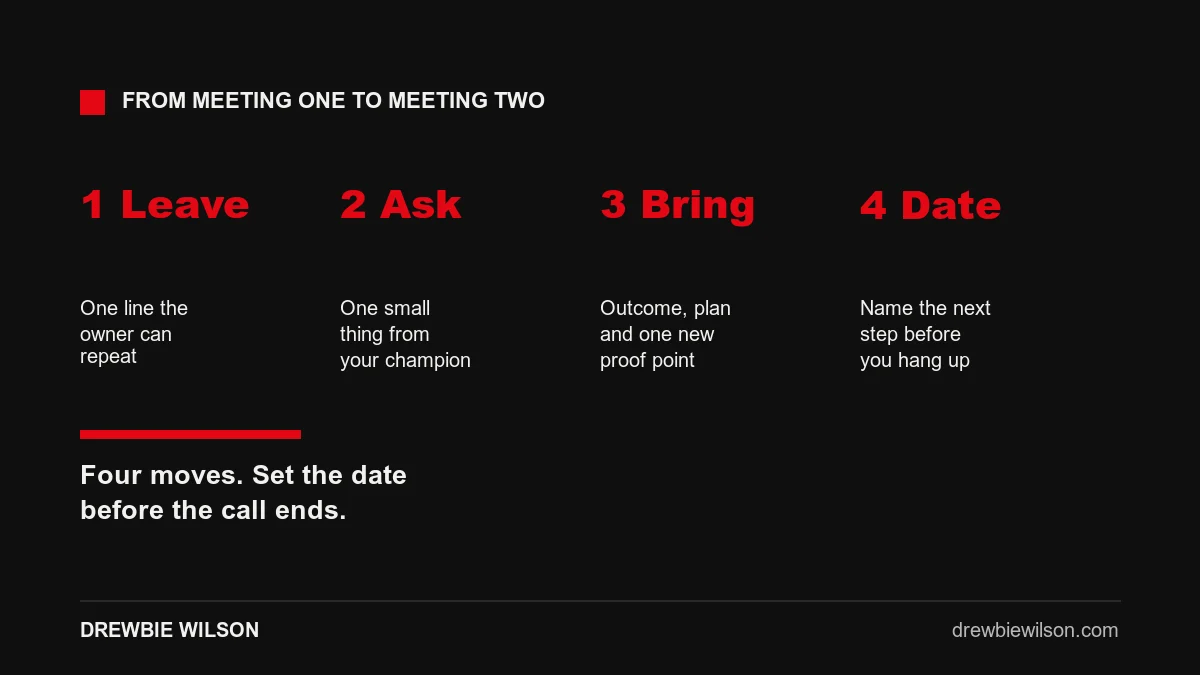
Before you hang up or leave the room, say one sentence that sums up what you heard and what it is worth to them. It should use their words, not yours.
For example: "You told me the missed renewals cost the team about a quarter of its target each year, and that you want that fixed before the next planning cycle." That is a line a budget owner can repeat to their boss in one breath. It sounds like their problem, not your pitch.
Then put the same sentence in the follow-up email, at the top, with nothing else above it. The note should be short enough to read on a phone. It is not a recap of the whole call. It is the line you want forwarded.
This is the Listen step of the C.A.L.L.S. Framework doing its job: reflect it back so they feel heard, and so the next step starts from their problem. The step after it, Lay out a plan, is what meeting two is built on. Call The Damn Leads walks through the full C.A.L.L.S. sales framework if you want all five steps in one place.
Many reps ask their champion, "Can you get me in front of the budget owner again?" It is a big ask with no shape, and it is easy to say "let me see what I can do" and never do it. A request your champion can complete in one sentence is easier to say yes to.
Try one of these:
Each of these is small, specific and in the champion's voice. It also tells you something. A champion who says yes to a fifteen-minute ask is still in your corner. How fast they answer a small ask is a fair read on how much weight they carry with the owner.
Who carries the ask depends on the situation. Match the move to the position you are really in.
| Situation | Who carries the ask | What you say | What a yes means | What a deferral means |
|---|---|---|---|---|
| Champion is strong and has access | Champion | "Would you ask if fifteen minutes next week works for the plan?" | Date set, agenda agreed | Priority is lower than you thought |
| Owner joined meeting one and was engaged | You, copying the champion | "You said X matters before planning. Can I show you the numbers on it in fifteen minutes?" | You are in the process | Ask for a named later date |
| Owner said little or seemed distracted | Champion, with a short written note | "Here is the one-line summary, and the plan if you want it." | They read it and want more | The case is not yet in their words |
| Champion cannot get the meeting | You, via the second contact | "Who owns the decision on this, and what do they need to see?" | You learn the path | The deal may not have an owner yet |
In every row, the ask has a size, a time and a person. "Fifteen minutes next week" is easy to say yes to. "Let's find time to connect" is not.
Timing matters as much as wording. Make the ask while the first meeting is still fresh, ideally on the same call and no later than the next business day. A week later, the owner has moved on to other priorities and you are asking them to remember a conversation they have mostly forgotten. If the owner did not join live, ask your champion to share your one-line summary within a day, so the first impression is the one you wrote.
Also decide in advance what you will do if the answer is "not yet." A deferral with a named date is still a yes to the process. A deferral with no date is a no that has not been said out loud. Ask, "Would the week after the planning review be better?" and write down whatever date they give you.
The second meeting is not the first one with a bigger deck. The owner has already heard the story. They are now deciding whether it is worth moving forward, and they want to see the cost and the result in plain numbers.
Bring three things:
That is the Lay out a plan step in action. When you finish, ask for the next step before you leave: who needs to be involved, what has to happen before a decision, and what date you will talk again. If the owner asks who else should be at the table, the seat-by-seat list in the discovery post above has the answer.
The honest take. Some budget owners will not give you a second meeting, no matter how good the ask is. That is a fact about the deal, not a flaw in your approach. If you have asked twice, in two ways, through two people, you have your answer. Do not wait for a third.
Log the refusal and name what would change it, such as a new budget cycle or a new sponsor, then look at the account again when it happens. Every hour spent waiting on one owner is an hour taken from new conversations, and Call The Damn Leads makes the same argument in its 100/10/2 article.
When the same deals stall between meeting one and meeting two, the pattern is worth fixing. Enterprise sales training from Drewbie helps reps map the committee and build more than one way in on their own live accounts. If the stall lands on the same stage every quarter, sales consulting starts with an audit of your sales process to find it.
If the stall is a contact who stopped replying rather than a budget owner who never booked, what to do when your buying committee champion is unresponsive covers the next two weeks.
Enterprise sales training helps reps map the committee and build more than one way in, using their own live accounts.
Get enterprise sales trainingSources: Call The Damn Leads, the C.A.L.L.S. sales framework · Call The Damn Leads, the discovery sales process · Call The Damn Leads, the 100/10/2 standard