
Most discovery advice assumes one buyer on the other end of the call. Real deals have a group, and the group does not share one set of worries. A question that works on the person who asked for the demo lands badly on the person who has to sign the contract. Discovery questions by buying committee role fix that by treating every seat as its own short discovery call with its own goal.
Here is the question set I would run seat by seat, in the order most deals open up, with the answer that should make you slow down.
Every enterprise deal carries more people than the one who answered your form. Harvard Business Review has written about the growing number of stakeholders involved in each purchase. The common mistake on these deals is a habit: reps run one good discovery call with the first person who replied, then treat that person's answers as the whole deal.
That person is usually your champion. They are useful, and they are also one view of the deal. What they believe about budget, timing and who objects is a hypothesis until someone in that seat says it too.
The fix is to split discovery into short, role-specific conversations. In the C.A.L.L.S. Framework, Ask is the second step: Confirm the reason you are speaking, Ask, Listen and take CRM notes, Lay out a plan, Secure the bag. The C.A.L.L.S. Framework tells reps to keep five to eight go-to questions ready for every call. On a committee deal, you keep that set ready for each seat, and each set is a little different. The general technique for asking a good question is covered in how to ask better sales questions. This post is about who gets which question.
The economic buyer owns the budget and can say yes without asking anyone else. You rarely get long with them, so the questions are short and about outcomes, not features.
Listen for the cost of doing nothing in their words. If they cannot name one, the project is a nice-to-have, and nice-to-haves lose to everything else.
The technical evaluator is checking fit and risk. Their job is to find the reasons it will not work, so do not be surprised when the conversation feels like an examination. Give them room.
These are two different seats that tend to show up late. Procurement owns process and timing. The end users own daily reality. Reps who skip either one get surprised in the last month.
For procurement, ask about the steps, not the price.
For the end users, ask what the work looks like today.
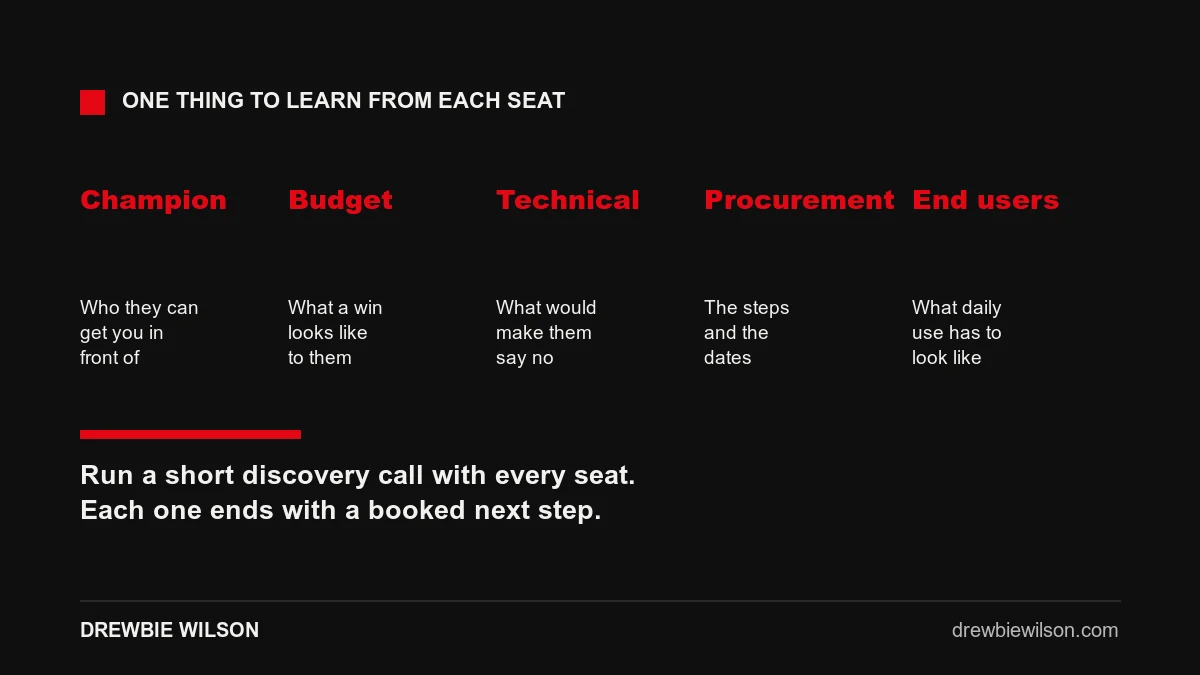
Your champion is the one person on the committee who wants this to happen. Ask them for access and honesty, not enthusiasm.
A champion who cannot get you in front of the economic buyer is giving you information. Treat it as such.
Start with the champion, because they open the doors. Go next to whichever seat is most likely to say no, which is usually the technical evaluator. An early objection is cheap to handle. The same objection in the last week of the quarter is not.
Take the economic buyer third, and take them with something in hand: what you learned from the champion about their goals and what the technical seat confirmed about fit. A budget owner who hears their own priorities repeated back accurately will give you more time than one who hears a feature tour. Procurement and the end users come last in most deals, but ask about procurement's steps earlier than feels natural. The date their process starts is rarely the date your proposal lands.
After every conversation, do three things in the CRM before you close the tab: the person's name and seat, their answer to the win question in their own words, and the next step with a date. That record is what lets a second rep, or a manager in a deal review, see the committee without asking you.
Print this and keep it next to the CRM record. It is the same set of questions in one place, with the answer that should make you slow down.
| Seat | What they own | Two questions to ask | The answer that should worry you |
|---|---|---|---|
| Economic buyer | The budget and the yes | What would make this a good decision in six months? What has to happen before you can approve it? | They cannot name a cost of doing nothing |
| Technical evaluator | Fit, risk and integration | What would make this not a fit? Who else signs off on the technical side? | A vague "it looks fine" with no named concern |
| Procurement | Process and timing | What happens between a yes and a signed agreement? What do you need from us, and how long does each step take? | Steps they cannot describe, or reviewers they will not name |
| End users | Daily use and adoption | When did this last go wrong for you? What would it have to do on a normal Tuesday? | They have never heard of the project |
| Champion | Access and the internal story | Who else is weighing in? Who can you introduce me to? | They cannot or will not open the budget owner's door |
If you are building the full picture of who sits where, enterprise sales training from Drewbie takes reps through committee mapping and multithreading on the open deals in their own pipeline, so the question sheet gets used on real accounts and not a case study. For deals where the problem sits in the process underneath the selling, sales consulting looks at the sales process, the follow-up and the pipeline together.
The honest take. No set of questions will rescue a deal where you have no access to the person who owns the budget. If every conversation runs through one friendly contact and nobody else will take your call, you are not in a committee deal yet. You are in a long conversation with an enthusiast. Spend the next week finding a second thread, and stop polishing the questions for the first one.
The second thing that does not help is asking all five sets of questions on a single call. Each seat gets its own conversation, and each conversation ends with a booked next step. For the basics of discovery before you split it by seat, Call The Damn Leads has a guide to the discovery sales process that covers the foundation this post builds on.
Enterprise sales training covers committee mapping and multithreading, built around your real accounts and scoped on one call.
Get enterprise sales trainingSources: Harvard Business Review, The New Sales Imperative · Call The Damn Leads, the discovery sales process · Call The Damn Leads, the C.A.L.L.S. sales framework