
What to Expect From 1:1 Sales Coaching (Week by Week, No Fluff)

what to expect from 1 on 1 sales coaching week by week

TL;DR
  • 1 on 1 sales coaching is a private, recurring working session where a coach audits your real numbers and real calls, then drills the fixes with you. It is not a course, not a webinar, and not a hype call.
  • The first session is an audit, not a lecture. You bring 30 days of activity data and two recorded calls. The coach finds the leak before anyone talks about "mindset."
  • Weeks 1 to 4 install a daily standard. In Drewbie's world that is the 100/10/2 Standard: 100 attempts, 10 real conversations, 2 booked appointments, every working day.
  • By day 90 the math has to show up. More conversations, more appointments, shorter gaps between follow-ups. If a coach cannot point to those numbers, you are paying for a friend.

Ask ten people what 1 on 1 sales coaching actually looks like and you get ten shrugs. Most reps sign up imagining a weekly pep talk. Then they either get exactly that and waste their money, or they get real coaching and are shocked that it feels more like a gym session than a therapy session.

I have spent 20+ years in sales and closed $15M+ in personal sales, and here is the truth up front: good coaching is an audit with reps attached. This post walks you through what actually happens, session by session, so you know what to expect, what to bring, and how to tell inside 90 days whether it is working. Steal the checklists even if you never hire anyone.

What 1 on 1 sales coaching actually is (and what it is not)

The consensus definition is right: one on one sales coaching is a private, ongoing engagement where a coach reviews your specific pipeline, your specific calls, and your specific numbers, then builds a personal improvement plan with you. That personalization is the whole point. Group training teaches the playbook. Coaching watches YOU run the play and corrects your form in real time.

What it is not:

  • Not a course. If you can complete it without anyone hearing you sell, it is content, not coaching.
  • Not accountability theater. "Did you do your calls? Cool, see you next week" is a check-in, not a coach.
  • Not motivation on a subscription. Motivation wears off by Thursday. Standards do not. If you want the difference spelled out, read sales coaching vs sales training.

The test I give people: after every session you should walk away with one specific thing to change, one way to measure it, and a date it gets reviewed. No specifics, no coaching.

Session one: the audit (bring these five things)

A real coach does not open with your goals. They open with your numbers, because the numbers never lie and feelings always do. Expect your first session to be a full teardown of the last 30 days. Show up with:

  1. Your activity counts. Dials or outreach attempts, real conversations, appointments booked, deals closed. Pull them from your CRM even if the data is ugly. Ugly data is data.
  2. Two recorded calls. One you thought went well, one that went sideways. The sideways one is worth more.
  3. Your current follow-up cadence. How many touches a new lead gets, on what days, in what channels. Most reps discover here that "cadence" is a generous word for what they do.
  4. Your calendar from last week. Where the hours actually went. Admin hiding-places show up fast.
  5. One number you want to change. Income, close rate, appointments per week. Pick one. Coaching that chases five numbers moves zero.

By the end of session one you should hear a sentence like: "Your problem is not closing, it is that you only had 11 real conversations last week." That sentence is worth the whole month.

Weeks 1 to 4: installing the standard (the 100/10/2 math)

The first month of coaching is rarely about technique. It is about volume, because most "skill problems" are starvation problems. This is where I install the 100/10/2 Standard: 100 attempts, 10 real conversations, 2 booked appointments, every working day. The standard has an origin story too; the original 100/10/2 write-up on Call The Damn Leads is where it was first published.

Run the math on what that compounds into:

  • 2 appointments a day = 10 a week = roughly 40 a month.
  • Close a conservative 20% of appointments and that is 8 closed deals a month from activity alone, before your skills improve at all.
  • Average deal worth $2,500? That is $20,000 a month of pipeline output riding on nothing but the standard.

Compare that to the rep averaging 15 attempts a day and wondering why coaching "is not working." No coach on earth can out-coach an empty pipeline. Expect your coach to hold the standard before they polish a single objection response. If yours does not ask about daily activity in the first two weeks, that is a red flag with a spotlight on it.
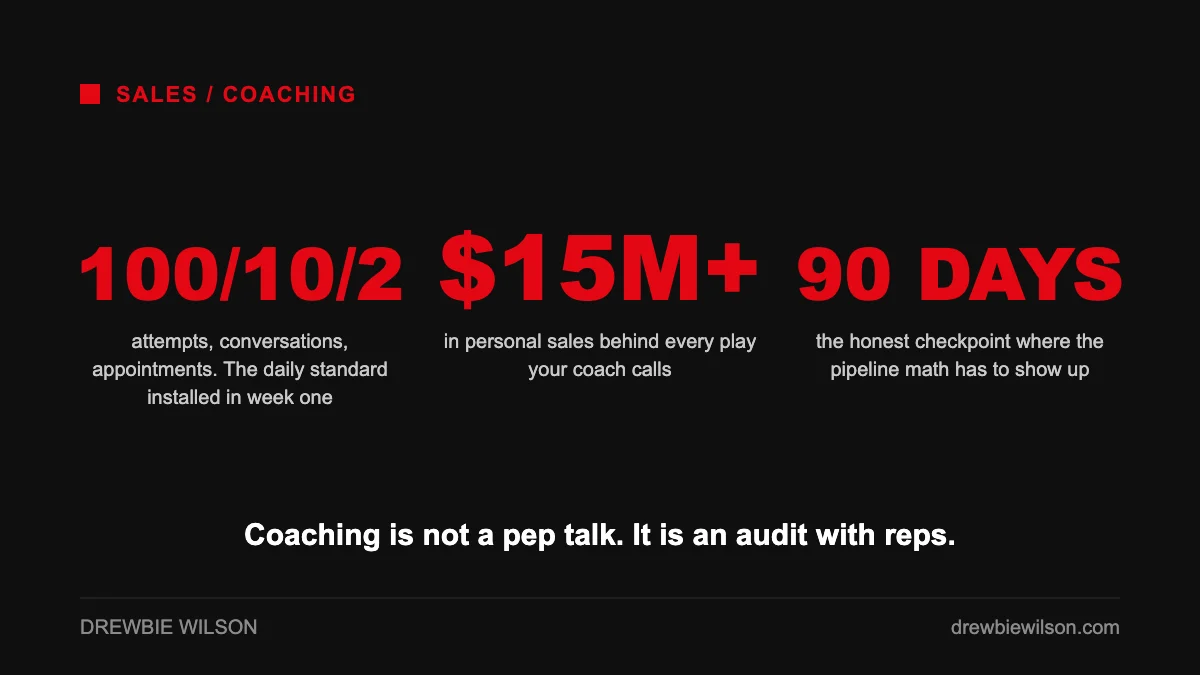
three numbers that define a sales coaching engagement audit standard and checkpoint

The weekly rhythm: what a coaching week looks like

Here is the working cadence of a real engagement once the standard is installed. Your version may shift by a day, but the shape should look like this:

DayWhat happensWhat you bringMetric reviewed
MondayLive 1:1 session (45 to 60 min): call review + one drill2 recorded calls, last week's scorecardConversations per day
Tuesday to ThursdayYou run call blocks against the standardDaily one-line activity log100/10/2 hit or missed
WednesdayAsync check: coach reviews one call clip, sends notesOne 5-minute call clipOne skill focus (openers, asks, closes)
FridayScorecard submitted: numbers plus one win, one leakWeekly totalsAppointments booked

Notice what is missing: homework packets, personality assessments, vision boards. Coaching that works is boring on paper and uncomfortable on the phone. That is the deal.

Call review: the C.A.L.L.S. walkthrough

The heart of every session is call review, and you need a shared language for it or feedback turns into vibes. Mine is the C.A.L.L.S. Framework, and here is exactly what a coach listens for at each step of your recording:

  • Confirm. Did you confirm who you are talking to and why the conversation is happening, in the first 30 seconds? Or did you launch into a pitch at a stranger?
  • Ask. Count your questions in the first five minutes. Fewer than three means you were presenting, not selling.
  • Listen. The brutal one. A coach will literally clock your talk time. If you are above 60%, the prospect never got to sell themselves.
  • Lay Out a Plan. Did the prospect leave knowing exactly what happens next, with a date on it? "I'll follow up soon" is where deals go to die.
  • Secure the Bag. Did you actually ask? Directly? Most stalled deals trace back to a close that never got asked for out loud.

Expect to be scored on all five, on real recordings, most weeks. It stings for about three sessions. Then your calls start sounding different and the sting turns into a scoreboard.

Real talk: if a coach never listens to your actual calls, they are not coaching you. They are coaching a character you play in your own retelling, and that character always sold better than you did. Recordings or it did not happen.

How to know it is working: the 30/60/90 checkpoints

Do not judge coaching by how fired up you feel. Judge it by leading indicators first, results second:

  • Day 30: activity is at or near standard. Conversations per week are up. You can recite your opener cold.
  • Day 60: appointments per week are up, follow-up gaps have shrunk from "whenever" to a fixed cadence, and your talk-time on calls is trending down.
  • Day 90: closed deals and pipeline value are visibly moving, and you can point at the specific behavior that moved them.

The research backs the checkpoint discipline: a Harvard Business Review analysis of sales coaching found that real coaching moves core performers the most, with quality coaching lifting the middle of the pack by up to 19%. Translation: coaching pays when it is measured, on the reps who actually do the work.

Write these checkpoints down before you start and review them with your coach on the calendar dates. A good coach will beat you to it, because their renewal case IS your scoreboard. If you get a wobble on the phone before those call blocks even start, fix that first: how to overcome call reluctance.

Five questions to ask before you hire anyone

Print these and ask them on the discovery call:

  1. "What numbers will you ask me for every week?" No concrete answer, no deal.
  2. "Will you review my actual call recordings?" Anything but yes is a pass.
  3. "What does your daily activity standard look like?" You want a number, not a philosophy.
  4. "What should be different at day 90, specifically?" Vague futures are a sales pitch, not a plan.
  5. "Have you personally carried a quota?" You want scars, not certificates. I put 20+ years and $15M+ in personal sales behind every play I call, and you should demand the same receipts from anyone you pay.

If you want the version of all this where the audit, the standard, and the weekly call reviews are done with you instead of by you, that is exactly what 1:1 sales coaching with Drewbie is built to do.

The bottom line

Expect an audit, not applause. Expect a daily standard before a single slick technique. Expect your real calls on the table every week, scored against a framework, with numbers that either move by day 90 or tell you to change something. That is what 1 on 1 sales coaching looks like when it is real, and now you know exactly what to demand.

The leads are already there. Call them.

Want a coach who counts your numbers, not your feelings?

Drewbie runs 1:1 coaching the way it is described above: audit first, standard second, reps forever. Bring your ugly CRM data. That is the fun part.

Work With Drewbie

Sources: Sales coaching impact on core performers via Harvard Business Review, "The Dirty Secret of Effective Sales Coaching". The 100/10/2 Standard and C.A.L.L.S. Framework are Drewbie Wilson's own published methodology; origin write-up on Call The Damn Leads.

What is 1 on 1 sales coaching?

It is a private, recurring engagement where a coach works directly with one salesperson: auditing their real activity numbers, listening to their actual recorded calls, and drilling specific fixes week over week. Unlike group training, everything is built around your pipeline and your calls. If it could happen without anyone ever hearing you sell, it is a course, not coaching.

Training teaches the playbook to a group: techniques, frameworks, product knowledge. Coaching watches one person run the play and corrects their form: your calls, your numbers, your habits, reviewed on a schedule. Most reps need training once and coaching continuously. The full breakdown is in the sales coaching vs sales training guide on this site.

A working audit. You bring 30 days of activity data, two recorded calls, your follow-up cadence, and last week’s calendar. The coach identifies the biggest leak, usually volume or follow-up rather than closing, and sets the daily standard you will run in month one. If a first session is mostly a motivational conversation, that is a warning sign.

It is Drewbie Wilson’s daily activity standard: 100 attempts, 10 real conversations, and 2 booked appointments every working day. It gets installed in the first weeks of coaching because most skill problems are actually starvation problems. At 2 appointments a day you book roughly 40 a month, and even a 20% close rate turns that into 8 deals monthly on volume alone.

Judge it in 30/60/90 windows. By day 30 your activity should be at standard and conversations up. By day 60, appointments are up and follow-up gaps have shrunk. By day 90, closed deals and pipeline value should be visibly moving. Feelings can improve in a week; numbers need a quarter. Any coach promising closed-deal jumps in two weeks is selling you adrenaline.

Often more than for rookies. Veterans carry invisible habits: talking 70% of the call, skipping the direct ask, coasting on referrals while daily activity quietly dies. A coach with a scorecard catches what 15 years of experience has learned to excuse. The test is the same at any level: are your numbers moving by day 90?

C.A.L.L.S. is Drewbie’s call framework: Confirm, Ask, Listen, Lay Out a Plan, Secure the Bag. In coaching it works as a scoring rubric for recorded calls. Your coach checks whether you confirmed the reason for the call, asked enough questions, kept your talk time down, set a dated next step, and actually asked for the business. Scored weekly, it turns “be better on calls” into five measurable behaviors.

By Drewbie Wilson. Keynote speaker, sales trainer, and the guy who built a brand on three words: Call The Damn Leads.

Related reading: Sales Coaching vs Sales Training · How to Overcome Call Reluctance